<?xml version="1.0" encoding="utf-8"?><feed xmlns="http://www.w3.org/2005/Atom" ><generator uri="https://jekyllrb.com/" version="3.10.0">Jekyll</generator><link href="/jekyll-algolia-example/feed.xml" rel="self" type="application/atom+xml" /><link href="/jekyll-algolia-example/" rel="alternate" type="text/html" /><updated>2025-12-08T10:50:42+00:00</updated><id>/jekyll-algolia-example/feed.xml</id><title type="html">jekyll-algolia example</title><subtitle>Write an awesome description for your new site here. You can edit this line in _config.yml. It will appear in your document head meta (for Google search results) and in your feed.xml site description.</subtitle><entry><title type="html">Label նկարագրություն</title><link href="/jekyll-algolia-example/2025/12/08/label.html" rel="alternate" type="text/html" title="Label նկարագրություն" /><published>2025-12-08T10:12:41+00:00</published><updated>2025-12-08T10:12:41+00:00</updated><id>/jekyll-algolia-example/2025/12/08/label</id><content type="html" xml:base="/jekyll-algolia-example/2025/12/08/label.html"><![CDATA[<h1 id="պիտակի-նկարագրություն">Պիտակի նկարագրություն</h1>

<p>Նախատեսված է փաստաթղթի վրա մուտքագրվող դաշտերի արանքում որևէ տողում տեքստ ցույց տալու համար։</p>

<h2 id="շարահյուսություն">Շարահյուսություն</h2>

<pre><code class="language-as4x">Label {
    Name = sLabelName;
    Caption = sLabelCaption;  
    ECaption = sLabelECaption;
    Alignment = sLabelAlignment;
    DisplayAtRight = nDisplayAtRight;
    Distance = nDistance; 
}; 
</code></pre>

<table>
  <thead>
    <tr>
      <th>Պարամետր</th>
      <th>Նկարագրություն</th>
    </tr>
  </thead>
  <tbody>
    <tr>
      <td>sLabelName</td>
      <td>Պիտակի ներքին անուն։</td>
    </tr>
    <tr>
      <td>sLabelCaption</td>
      <td>Պիտակի տեքստը։</td>
    </tr>
    <tr>
      <td>sLabelECaption</td>
      <td>Պիտակի տեքստը օտար լեզվով։</td>
    </tr>
    <tr>
      <td>sLabelAlignment</td>
      <td>Պիտակի դիրքը տողի վրա։ <br /> <code class="language-plaintext highlighter-rouge">LEFT</code> արժեքի դեպքում պիտակի տեքստը գրվում է տողում ձախ կողմից, <br /> <code class="language-plaintext highlighter-rouge">RIGHT</code>-ի դեպքում՝ աջ կողմից, <br /> <code class="language-plaintext highlighter-rouge">CENTER</code>-ի դեպքում՝ մեջտեղում։ <br /> Լռությամբ արժեքը <code class="language-plaintext highlighter-rouge">LEFT</code>։</td>
    </tr>
    <tr>
      <td>sDisplayAtRight</td>
      <td>0 արժեքի դեպքում պիտակը տեղադրվում է նոր տողում։ <br /> 1 արժեքի դեպքում՝ նախորդ դաշտի աջ կողմից <code class="language-plaintext highlighter-rouge">Distance</code> հեռավորության վրա։ <br /> 2 արժեքի դեպքում պիտակը տեղադրվում է նախորդ դաշտի տողում պատուհանի ձախ եղրից <code class="language-plaintext highlighter-rouge">Distance</code> հեռավորության վրա։ <br /> Լռությամբ արժեքը 0։</td>
    </tr>
    <tr>
      <td>nDistance</td>
      <td>Պիտակի հեռավորությունը նախորդ դաշտից կամ պատուհանի եզրից։ Տե՛ս <code class="language-plaintext highlighter-rouge">DisplayAtRight</code>:</td>
    </tr>
  </tbody>
</table>

<h2 id="նկատառումներ">Նկատառումներ</h2>

<p><code class="language-plaintext highlighter-rouge">DisplayAtRight</code>-ի 1,2 արժեքների դեպքում <code class="language-plaintext highlighter-rouge">Alignment</code>-ի արժեքը անտեսվում։</p>]]></content><author><name>Gaetan</name></author><summary type="html"><![CDATA[Պիտակի նկարագրություն]]></summary></entry><entry><title type="html">Welcome to Jekyll!</title><link href="/jekyll-algolia-example/jekyll/update/2017/12/20/welcome-to-jekyll.html" rel="alternate" type="text/html" title="Welcome to Jekyll!" /><published>2017-12-20T10:12:41+00:00</published><updated>2017-12-20T10:12:41+00:00</updated><id>/jekyll-algolia-example/jekyll/update/2017/12/20/welcome-to-jekyll</id><content type="html" xml:base="/jekyll-algolia-example/jekyll/update/2017/12/20/welcome-to-jekyll.html"><![CDATA[<p>You’ll find this post in your <code class="language-plaintext highlighter-rouge">_posts</code> directory. Go ahead and edit it and re-build the site to see your changes. You can rebuild the site in many different ways, but the most common way is to run <code class="language-plaintext highlighter-rouge">jekyll serve</code>, which launches a web server and auto-regenerates your site when a file is updated.</p>

<p>To add new posts, simply add a file in the <code class="language-plaintext highlighter-rouge">_posts</code> directory that follows the convention <code class="language-plaintext highlighter-rouge">YYYY-MM-DD-name-of-post.ext</code> and includes the necessary front matter. Take a look at the source for this post to get an idea about how it works.</p>

<p>Jekyll also offers powerful support for code snippets:</p>

<figure class="highlight"><pre><code class="language-ruby" data-lang="ruby"><span class="k">def</span> <span class="nf">print_hi</span><span class="p">(</span><span class="nb">name</span><span class="p">)</span>
  <span class="nb">puts</span> <span class="s2">"Hi, </span><span class="si">#{</span><span class="nb">name</span><span class="si">}</span><span class="s2">"</span>
<span class="k">end</span>
<span class="n">print_hi</span><span class="p">(</span><span class="s1">'Tom'</span><span class="p">)</span>
<span class="c1">#=&gt; prints 'Hi, Tom' to STDOUT.</span></code></pre></figure>

<p>Check out the <a href="https://jekyllrb.com/docs/home">Jekyll docs</a> for more info on how to get the most out of Jekyll. File all bugs/feature requests at <a href="https://github.com/jekyll/jekyll">Jekyll’s GitHub repo</a>. If you have questions, you can ask them on <a href="https://talk.jekyllrb.com/">Jekyll Talk</a>.</p>

<pre><code class="language-as4x">Label {
    Name = sLabelName;
    Caption = sLabelCaption;  
    ECaption = sLabelECaption;
    Alignment = sLabelAlignment;
    DisplayAtRight = nDisplayAtRight;
    Distance = nDistance; 
}; 
</code></pre>

<table>
  <thead>
    <tr>
      <th>Պարամետր</th>
      <th>Նկարագրություն</th>
    </tr>
  </thead>
  <tbody>
    <tr>
      <td>sLabelName</td>
      <td>Պիտակի ներքին անուն։</td>
    </tr>
    <tr>
      <td>sLabelCaption</td>
      <td>Պիտակի տեքստը։</td>
    </tr>
    <tr>
      <td>sLabelECaption</td>
      <td>Պիտակի տեքստը օտար լեզվով։</td>
    </tr>
    <tr>
      <td>sLabelAlignment</td>
      <td>Պիտակի դիրքը տողի վրա։ <br /> <code class="language-plaintext highlighter-rouge">LEFT</code> արժեքի դեպքում պիտակի տեքստը գրվում է տողում ձախ կողմից, <br /> <code class="language-plaintext highlighter-rouge">RIGHT</code>-ի դեպքում՝ աջ կողմից, <br /> <code class="language-plaintext highlighter-rouge">CENTER</code>-ի դեպքում՝ մեջտեղում։ <br /> Լռությամբ արժեքը <code class="language-plaintext highlighter-rouge">LEFT</code>։</td>
    </tr>
    <tr>
      <td>sDisplayAtRight</td>
      <td>0 արժեքի դեպքում պիտակը տեղադրվում է նոր տողում։ <br /> 1 արժեքի դեպքում՝ նախորդ դաշտի աջ կողմից <code class="language-plaintext highlighter-rouge">Distance</code> հեռավորության վրա։ <br /> 2 արժեքի դեպքում պիտակը տեղադրվում է նախորդ դաշտի տողում պատուհանի ձախ եղրից <code class="language-plaintext highlighter-rouge">Distance</code> հեռավորության վրա։ <br /> Լռությամբ արժեքը 0։</td>
    </tr>
    <tr>
      <td>nDistance</td>
      <td>Պիտակի հեռավորությունը նախորդ դաշտից կամ պատուհանի եզրից։ Տե՛ս <code class="language-plaintext highlighter-rouge">DisplayAtRight</code>:</td>
    </tr>
  </tbody>
</table>

<h2 id="նկատառումներ">Նկատառումներ</h2>

<p><code class="language-plaintext highlighter-rouge">DisplayAtRight</code>-ի 1,2 արժեքների դեպքում <code class="language-plaintext highlighter-rouge">Alignment</code>-ի արժեքը անտեսվում։</p>]]></content><author><name></name></author><category term="jekyll" /><category term="update" /><summary type="html"><![CDATA[You’ll find this post in your _posts directory. Go ahead and edit it and re-build the site to see your changes. You can rebuild the site in many different ways, but the most common way is to run jekyll serve, which launches a web server and auto-regenerates your site when a file is updated.]]></summary></entry><entry><title type="html">Welcome Texas!</title><link href="/jekyll-algolia-example/2015/07/15/new-distributed-search-network-texas.html" rel="alternate" type="text/html" title="Welcome Texas!" /><published>2015-07-15T00:00:00+00:00</published><updated>2015-07-15T00:00:00+00:00</updated><id>/jekyll-algolia-example/2015/07/15/new-distributed-search-network-texas</id><content type="html" xml:base="/jekyll-algolia-example/2015/07/15/new-distributed-search-network-texas.html"><![CDATA[<p class="deprecation-notice">
You probably already know it: any millisecond that end-users have to wait to
get their results drives us nuts. But what on Earth does this have to do with
Texas? Actually a lot!
</p>

<h2 id="you-want-your-search-to-be-instant-lets-talk-network">You want your search to be instant? Let’s talk network…</h2>

<p>When looking at the speed of search on a website or a mobile application, the
performance of the search engine is just one part of the equation. When you’re
using an extremely fast engine, network latency and saturated links quickly
become your biggest enemies: it simply takes time for the user query to reach
the engine and for the results to get back to the user’s browser.</p>

<p>In some cases, the round trip can easily take more than a second. In the US, it
can take up to 300ms to simply establish an SSL connection between the two
coasts.  All this also applies to the communications between your backend and
the servers that host your search engine. The network can simply ruin the real
time experience you hoped to offer with your search engine.</p>

<h2 id="a-new-us-central-point-of-presence-to-reach-a-25ms-total-delivery-time-across-the-us">A new US Central point of presence to reach a 25ms total delivery time across the US</h2>

<p>A great search experience is to drive end-users towards what they’re looking
as quickly and seamlessly as possible. For us at Algolia it means to be able
to dynamically update the content displayed as the end-user is typing a query.
Being able to offer this find as-you-type experience obviously requires a very
performant search engine but it also requires to host the search engine itself
as close as possible to the end-user in order to tackle the network latency.</p>

<p>This is why we are adding this new US Central region to our existing twelve
regions. With the addition of the Dallas PoP, Algolia’s API is now accessible
from thirteen different regions including US (East, West and Central),
Australia, Brazil, Canada, France, Germany, Hong Kong, India, Japan, Russia,
and Singapore.</p>

<p>If your audience is spread out across multiple regions, you can use Algolia
from a combination of these regions to ensure minimal results delivery time
and optimal speed for all your users (Algolia’s Distributed Search Network
automatically routes user queries to your closest region).</p>

<p>This new US Central PoP, combined with Algolia’s US East and US West PoPs, now
allows to deliver search results across the US with less than 25 milliseconds of
latency. This guarantees a seamless find-as-you-type experience on websites and
mobile applications all across the US.</p>

<p><a href="https://blog.algolia.com/wp-content/uploads/2015/07/dallas2.jpg"><img src="./assets/dallas2.jpg" alt="dallas2" /></a></p>

<h2 id="getting-closer-to-additional-infrastructure-providers">Getting closer to additional infrastructure providers</h2>

<p>When you choose SaaS providers, especially when their service becomes a core
component of your product, you probably prefer the ones hosted close to where
you operate your backend, for latency and availability reasons. This is
actually why we initially started in the US by opening PoPs in Ashburn (VA)
and San Jose (CA), close to the AWS PoPs, which most of our customers rely on
today.</p>

<p>Our new presence in Texas allows services which rely for their backend on
local infrastructure providers such as Rackspace and Softlayer to also benefit
from the full power of Algolia. This new PoP offers them an extremely low
network latency between their backend and our API.</p>

<p>If you’re not already an Algolia user and you want to give it a try, simply
<a href="https://www.algolia.com/users/sign_up">sign up</a> for a 14 day trial and select
the US Central region in the process.</p>

<p>If you are already using Algolia and want to migrate to the US Central region,
simply drop us a line at <a href="mailto:support@algolia.com">support@algolia.com</a> or
on the live chat.</p>

<p>If you’re none of the two above, we still think you’re awesome!</p>

<p>Cheers!</p>]]></content><author><name>Gaetan</name></author><summary type="html"><![CDATA[You probably already know it: any millisecond that end-users have to wait to get their results drives us nuts. But what on Earth does this have to do with Texas? Actually a lot!]]></summary></entry><entry><title type="html">When Solid State Drives are not that solid</title><link href="/jekyll-algolia-example/2015/06/15/when-solid-state-drives-are-not-that-solid.html" rel="alternate" type="text/html" title="When Solid State Drives are not that solid" /><published>2015-06-15T00:00:00+00:00</published><updated>2015-06-15T00:00:00+00:00</updated><id>/jekyll-algolia-example/2015/06/15/when-solid-state-drives-are-not-that-solid</id><content type="html" xml:base="/jekyll-algolia-example/2015/06/15/when-solid-state-drives-are-not-that-solid.html"><![CDATA[<p>It looked just like another page in the middle of the night. One of the
servers of our search API stopped processing the indexing jobs for an unknown
reason. Since we build systems in Algolia for high availability and
resiliency, nothing bad was happening. The new API calls were correctly
redirected to the rest of the <a href="http://highscalability.com/blog/2015/3/9/the-architecture-of-
algolias-distributed-search-network.html">healthy machines in the
cluster</a> and the only impact on the service
was one woken-up engineer. It was time to find out what was going on.</p>

<p>UPDATE June 16:<br />
<a href="https://hn.algolia.com/story/9723066/when-solid-state-drives-are-not-that-solid">A lot of
discussions</a>
started pointing out that the issue is related to the newly introduced queued
TRIM. This is not correct. The TRIM on our drives is un-queued and the issue we
have found is not related to the latest changes in the Linux Kernel to disable
this feature.</p>

<p>UPDATE June 17:<br />
We got contacted by Samsung and we provided them all the system specifications and all the information about the issue we had. We will continue to provide Samsung all the necessary information in order to resolve the issue.</p>

<p>UPDATE June 18:
We just had a conference call with the European branch and the Korean HQ of
Samsung. Their engineers are going to visit one of the datacenters we have
servers in and in cooperation with our server provider they will inspect the
mentioned SSDs in our SW and HW setup.</p>

<p>UPDATE June 19:<br />
On Monday June 22, the engineering team from Samsung is going analyze one of our servers in Singapore and if nothing is found on-site, the server will travel to Samsung HQ in Korea for further analysis.</p>

<p>UPDATE July 13:<br />
Since the last update of this blog-post, we have been in a cooperation with Samsung trying to help them find the issue, during this investigation we agreed with Samsung not to communicate until their approval.</p>

<p>As the issue was not reproduced on our server in Singapore, the reproduction
is now running under Samsung supervision in Korea, out of our environment.
Although Samsung requested multiple times an access to our software and
corrupted data, we could not provide it to them in order to protect the
privacy and data of our customers.</p>

<p>Samsung asked us to inform you about this:</p>

<ul>
  <li>Samsung tried to duplicate the failure with the latest script provided to them, but no single failure has been reproduced so far.</li>
  <li>Samsung will do further tests, most likely from week 29 onwards, with a much more intensive script provided by Algolia.</li>
</ul>

<p>After unsuccessful tries to reproduce the issue with Bash scripts we have
decided to help them by creating a small C++ program that simulates the
writing style and pattern of our application (no files are open with
O_DIRECT). We believe that if the issue is coming from a specific way we are
using the standard kernel calls, it might take a couple of days and terabytes
of data to be written to the drive.</p>

<p>We have been informed by Samsung that no issue of this kind have been reported
to them. Our server provider has modified their Ubuntu 14.04 images to disable
the fstrim cron in order to avoid this issue. For the last couple of months
after not using trim anymore we have not seen the issue again.</p>

<p>UPDATE July 17:<br />
We have just finished a conference call with Samsung
considering the failure analysis of this issue. Samsung engineering team has
been able to successfully reproduce the issue with our latest provided binary.</p>

<ul>
  <li>Samsung had a concrete conclusion that the issue is not related to Samsung SSD or Algolia software but is related to the Linux kernel.</li>
  <li>Samsung has developed a kernel patch to resolve this issue and the official statement with details will be released tomorrow, July 18 on Linux community with the Linux patch guide. Our testing code <a href="https://github.com/algolia/trimtester">is available on GitHub</a>.</li>
</ul>

<p>This has been an amazing ride, thank you everyone for joining, we have arrived
at the destination.</p>

<hr />

<p>The <a href="http://nginx.org/">NGINX</a> daemon serving all the HTTP(S) communication of
our API was up and ready to serve the search queries but the indexing process
crashed. Since the indexing process is guarded by
<a href="http://cr.yp.to/daemontools/supervise.html">supervise</a>, crashing in a loop
would have been understandable but a complete crash was not. As it turned out
the filesystem was in a read-only mode. All right, let’s assume it was a
cosmic ray :) the filesystem got fixed, files were restored from another
healthy server and everything looked fine again.</p>

<p>The next day another server ended with filesystem in read-only, two hours
after another one and then next hour another one. Something was going on.
After restoring the filesystem and the files, it was time for serious analysis
since this was not a one time thing. At this point, we did a breakdown of the
software involved in our storage stack and went through the recent changes.</p>

<h2 id="investigation--debugging-time">Investigation &amp; debugging time!</h2>

<p>We first asked ourselves if it could be related to our software. Are we using
non-safe system calls or processing the data in an unsafe way? Did we
incorrectly read and write the files in the memory before flushing it to disk?</p>

<ul>
  <li>Filesystem - Is there a bug in <a href="https://en.wikipedia.org/wiki/Ext4">ext4</a>? Can we access the memory space of allocation tables by accident?</li>
  <li><a href="https://raid.wiki.kernel.org/index.php/Linux_Raid">Mdraid</a> - Is there a bug in mdadm? Did we use an improper configuration?</li>
  <li>Driver - Does the driver have a bug?</li>
  <li><a href="https://en.wikipedia.org/wiki/Solid-state_drive">SSD</a> - Is the SSD dying? Or even worse, is there a problem with the firmware of the drive?</li>
</ul>

<p>We even started to bet where the problem was and exactly proposed, in this
order, the possible solutions going from easy to super-hard.</p>

<p>Going through storage procedures of our software stack allowed us to set up
traps and in case the problem happens again, we would be able to better
isolate the corrupted parts. Looking at every single storage call of our
engine gave us enough confidence that the problem was not coming from the way
in which we manipulate the data. Unfortunately.</p>

<p>One hour later, another server was corrupted. This time we took it out of the
cluster and started to inspect it bit by bit. Before we fixed the filesystem,
we noticed that some pieces of our files were missing (zeroed) - file
modification date was unchanged, size was unchanged, just some parts were
filled with zeros. Small files were completely erased.</p>

<p>This was weird, so we started to think if it was possible that our application
could access certain portions of the memory where the OS/filesystem had
something mapped because otherwise our application cannot modify a file without
the filesystem noticing. Having our software written in C++ brought a lot of
crazy ideas of what happened. This turned out to be a dead-end as all of these
memory blocks were out of our reach.</p>

<p>So is there an issue in the ext4? Going through the kernel changelog looking
for ext4 related issues was a terrifying experience. In almost every version
we found a fixed bug that could theoretically impact us. I have to admit, I
slept better before reading the changelog.</p>

<p>We had kernels 3.2, 3.10, 3.13 and 3.16 distributed between the most often
corrupted machines and waited to see which of the mines blows up. All of them
did. Another dead-end. Maybe there was an issue in ext4 that no one else has
seen before? The chance that we were this “lucky” was quite low and we did not
want to end up in a situation like that. The possibility of a bug in ext4 was
still open but highly improbable.</p>

<p>What if there was an issue in mdadm? Looking at the changelog gave us
confidence that we should not go down this path.</p>

<p>The level of despair was reaching a critical level and the pages in the middle
of the night were unstoppable. We spent a big portion of two weeks just
isolating machines as quickly as possible and restoring them as quickly as
possible. The one thing we did was to implement a check in our software that
looked for empty blocks in the index files, even when they were not used, and
alerted us in advance.</p>

<h2 id="not-a-single-day-without-corruptions">Not a single day without corruptions</h2>

<p>While more and more machines were dying, we had managed to automate the
restore procedure to a level we were comfortable with. At every failure, we
tried to look at different patterns of the corruption in hopes that we would
find the smallest common denominator. They all had the same characteristics.
But one thing started to be more and more clear - we saw the issue only on a
portion of our servers.</p>

<p>The software stack was identical but the hardware was slightly different. Mainly
the SSDs were different but they were all from the same manufacturer. This was
very alarming and led us to contact our server provider to ask if they have ever
seen something like this before. It’s hard to convince a technical support
person about a problem that you see only once in a while, with the latest
firmware and that you cannot reproduce on demand.  We were not very successful
but at least we had one small victory on our side.</p>

<p>Knowing that the issue existed somewhere in the combination of the software
and drive itself, we reproduced the identical software stack from our servers
with different drives. And? Nothing, the corruption appeared again. So it was
quite safe to assume the problem was not in the software stack and was more
drive related. But what causes a block to change the content without the rest
of the system noticing? That would be a lot of rotten bits in a sequence…</p>

<p>The days started to become a routine - long shower, breakfast, restoring
corrupted servers, lunch, restoring corrupted servers, dinner, restoring
corrupted servers. Until one long morning shower full of thinking, “how big
was the sequence?” As it turned out, the lost data was always 512 bytes, which
is one block on the drive.</p>

<p>One step further, a block ends up to be full of zeroes. A hardware bug? Or is
the block zeroed? What can zero the block?
<a href="https://en.wikipedia.org/wiki/Trim_(computing)">TRIM</a>! Trim instructs the SSD
drive to zero the empty blocks. But these block were not empty and other types
of SSDs were not impacted. We gave it a try and disabled TRIM across all of our
servers. It would explain everything!</p>

<p>The next day not a single server was corrupted, two days silence, then a week.
The nightmare was over! At least we thought so… a month after we isolated the
problem, a server restarted and came up with corrupted data but only from the
small files - including certificates. Even improper shutdown cannot cause
this.</p>

<p>Poking around in the source code of the kernel looking for the trim related
code, we came to the <a href="https://github.com/torvalds/linux/blob/e
64f638483a21105c7ce330d543fa1f1c35b5bc7/drivers/ata/libata-
core.c#L4109-L4286">trim blacklist</a>. This blacklist configures a specific behavior for certain
SSD drives and identifies the drives based on the regexp of the model name.
Our working SSDs were explicitly allowed full operation of the TRIM but some
of the SSDs of our affected manufacturer were limited. Our affected drives did
not match any pattern so they were implicitly allowed full operation.</p>

<h2 id="the-complete-picture">The complete picture</h2>

<p>At this moment we finally got a complete picture of what was going on. The
system was issuing a TRIM to erase empty blocks, the command got
misinterpreted by the drive and the controller erased blocks it was not
supposed to. Therefore our files ended-up with 512 bytes of zeroes, files
smaller than 512 bytes were completely zeroed. When we were lucky enough, the
misbehaving TRIM hit the super-block of the filesystem and caused a
corruption.</p>

<p>After disabling the TRIM, the live big files were no longer
corrupted but the small files that were once mapped to the memory and never
changed since then had two states - correct content in the memory and
corrupted one on the drive. Running a check on the files found nothing because
they were never fetched again from the drive and just silently read from the
memory. Massive reboot of servers came into play to restore the data
consistency but after many weeks of hunting a ghost we came to the end.</p>

<p>As a result, we informed our server provider about the affected SSDs and they
informed the manufacturer. Our new deployments were switched to different SSD
drives and we don’t recommend anyone to use any SSD that is anyhow mentioned
in a bad way by the Linux kernel. Also be careful, even when you don’t enable
the TRIM explicitly, at least since Ubuntu 14.04 the explicit
<a href="http://man7.org/linux/man-pages/man8/fstrim.8.html">FSTRIM</a> runs in a cron
once per week on all partitions - the freeze of your storage for a couple of
seconds will be your smallest problem.</p>

<h2 id="tldr">TL;DR</h2>

<h3 id="broken-ssds-drives-on-which-we-have-detected-the-issue"><del>Broken SSDs</del>: (Drives on which we have detected the issue)</h3>

<ul>
  <li>SAMSUNG MZ7WD480HCGM-00003</li>
  <li>SAMSUNG MZ7GE480HMHP-00003</li>
  <li>SAMSUNG MZ7GE240HMGR-00003</li>
  <li>
    <p>Samsung SSD 840 PRO Series<br />
recently blacklisted for 8-series blacklist</p>
  </li>
  <li>Samsung SSD 850 PRO 512GB<br />
recently blacklisted as 850 Pro and later in 8-series blacklist</li>
</ul>

<h3 id="working-ssds-drives-on-which-we-have-not-detected-the-issue"><del>Working SSDs</del>: (Drives on which we have NOT detected the issue)</h3>

<ul>
  <li>Intel S3500</li>
  <li>Intel S3700</li>
  <li>Intel S3710</li>
</ul>]]></content><author><name>Adam</name></author><summary type="html"><![CDATA[It looked just like another page in the middle of the night. One of the servers of our search API stopped processing the indexing jobs for an unknown reason. Since we build systems in Algolia for high availability and resiliency, nothing bad was happening. The new API calls were correctly redirected to the rest of the healthy machines in the cluster and the only impact on the service was one woken-up engineer. It was time to find out what was going on.]]></summary></entry><entry><title type="html">We just raised our Series A. What’s next?</title><link href="/jekyll-algolia-example/2015/05/28/we-just-raised-our-series-a-whats-next.html" rel="alternate" type="text/html" title="We just raised our Series A. What’s next?" /><published>2015-05-28T00:00:00+00:00</published><updated>2015-05-28T00:00:00+00:00</updated><id>/jekyll-algolia-example/2015/05/28/we-just-raised-our-series-a-whats-next</id><content type="html" xml:base="/jekyll-algolia-example/2015/05/28/we-just-raised-our-series-a-whats-next.html"><![CDATA[<p>You may have heard last week in the <a href="https://www.algolia.com/press">press</a>,
Algolia has just raised an $18.3M Series A round of financing led by Accel
Partners! Philippe Botteri from Accel is joining our board and we can’t wait
to benefit from his experience! We are also excited to welcome Lead Edge
Capital and to have received the trust of industry pioneers such as Ilya
Sukhar of Parse, Solomon Hykes of Docker, Erik Swan of Splunk, and Kevin Rose
of Digg.</p>

<p>This funding represents a major milestone for Algolia. Thanks to the
commitment of our customers our growth last year enabled us to demonstrate a
strong product market fit. We are proud to count many of you as our customers
who have seen in our offer a way to deliver a better search experience,
improving their end-users’ engagement.</p>

<p>We want to change the way people interact with information. We don’t want
people to “search” in the traditional type-keyword/hit-enter/wait-for-results
/repeat-until-found-or-abandon way; we want them to intuitively access data.
We strongly believe that search should become a frontend and UX priority.
That’s why we focus so much on the two must-haves for building a seamless and
interactive experience: speed which enables updating results as-you-type, and
relevance which ensures that results are good even after only a couple of
keystrokes.</p>

<p>It’s time for us to accelerate on that vision. With the help of this new
funding, we are going to continue investing in our core product, and in making
it available to an ever-expanding community with many new integrations. Search
is everywhere and you can count on us to come up with new creative ways to
delight your users with an outstanding experience. Stay tuned!</p>

<p>We will also double down on customer success, which has been so important to
our growth. Please make us accountable and let us know if there is anything we
can improve.</p>

<p>We have embarked on a journey to change the face of user-facing search,
everywhere. Join us, it’s going to be fun!</p>

<p>PS: We’re <a href="https://www.algolia.com/jobs">hiring</a>!</p>]]></content><author><name>Nicolas</name></author><summary type="html"><![CDATA[You may have heard last week in the press, Algolia has just raised an $18.3M Series A round of financing led by Accel Partners! Philippe Botteri from Accel is joining our board and we can’t wait to benefit from his experience! We are also excited to welcome Lead Edge Capital and to have received the trust of industry pioneers such as Ilya Sukhar of Parse, Solomon Hykes of Docker, Erik Swan of Splunk, and Kevin Rose of Digg.]]></summary></entry><entry><title type="html">DNS fallback for better resilience</title><link href="/jekyll-algolia-example/2015/05/11/dns-fallback-for-better-resilience.html" rel="alternate" type="text/html" title="DNS fallback for better resilience" /><published>2015-05-11T00:00:00+00:00</published><updated>2015-05-11T00:00:00+00:00</updated><id>/jekyll-algolia-example/2015/05/11/dns-fallback-for-better-resilience</id><content type="html" xml:base="/jekyll-algolia-example/2015/05/11/dns-fallback-for-better-resilience.html"><![CDATA[<p>At Algolia, we are obsessed with finding a way to have a 99.9999% available
architecture. On our way to achieve that, we have to make sure every piece of
the architecture can safely fail without affecting the service.</p>

<p>The first point of the architecture where a customer’s request starts to
interact with our service is not the router in the datacenter, but a DNS
resolving a domain name to the IP address “long time” before that. This piece
of architecture is very often overlooked and that is no surprise as you mostly
get best-effort DNS service automatically with your server.</p>

<h2 id="latency">Latency</h2>

<p>For couple months we are a happy user of <a href="https://nsone.net">NSONE</a> that
provides us with the first level of logic. We use NSONE for its superb
performance and data-driven DNS that gives us control in steering the traffic
of our <a href="https://www.algolia.com/dsn">Distributed Search Network</a> to the proper
server - whether it means closest or simply available one. But as any other
network dependent service, there are factors outside of NSONE’s control that
can influence availability of its DNS resolves and consequently Algolia. BGP
routing is still a huge magic and “optimizations” of some ISPs are beyond
understanding. Well, they do not always make the optimizations in the
direction we would like to. For some services the change of DNS resolution
time from 10 to 500ms does not mean a lot but for us it is a deal breaker.</p>

<p><a href="https://blog.algolia.com/wp-content/uploads/2015/05/nsone-dig-latency.png"><img src="./assets/nsone-dig-latency.png" alt="nsone-dig-latency" /></a> Resolution of latency-1 via NSONE</p>

<h2 id="ddos">DDoS</h2>

<p>When we started to think about our DNS dependency, we remembered the <a href="https://threatpost.com/ultradns-dealing-with-ddos-attack/105806">2014
DDoS attack on UltraDNS</a> and the situation when there was not enough
<a href="https://twitter.com/hashtag/hugops">#hugops</a> for all the services impacted.
During the previous <a href="http://www.zdnet.com/article/ddos-attack-on-ultradns-affects-amazon-com-salesforce-com-petco-com/">attack on UltraDNS in 2009</a> even
big names like Amazon and SalesForce got impacted.</p>

<h2 id="solution">Solution</h2>

<p>In most of the cases it would mean adding another DNS name server from a
different provider and replicate the records. But not in ours. NSONE has some
unique features that we would have to give up and find a common feature subset
with a different provider. In the end we would have to serve a portion of DNS
resolutions via slower provider for no good reason.</p>

<p>Since we provide custom made API clients we have one more place where to put
additional logic. Now came a time to choose a resilient provider for our
secondary DNS and since we like AWS, Route53 was a clear choice. Route53 has
ok performance, many POPs around the world and API we already had integration
for.</p>

<p>In the last moment, one more paranoid idea came to us - let’s not rely on a
single <a href="http://en.wikipedia.org/wiki/Top-level_domain">TLD</a>. No good reason
for that, it was just “what if…?” moment.</p>

<p><a href="https://blog.algolia.com/wp-content/uploads/2015/05/route53-dig-latency.png"><img src="./assets/route53-dig-latency.png" alt="route53-dig-latency" /></a> Resolution of latency-1 via
Route53</p>

<p>Right now, all the latest versions of our API clients (detailed list below)
use multiple domain names. “algolia.net” is served by NSONE and provides all
the speed and intelligence, “algolianet.com” is served by Route53 in case that
for any reason contacting server via “algolia.net” fails. It brings more work
to our side, brings more cost on our side but it also brings better sleep for
our customers, their customers and us.</p>

<p>And now we can think what else can fail…</p>

<p>Minimal versions of API clients with support of multiple DNS:</p>

<ul>
  <li><a href="https://github.com/algolia/algoliasearch-client-js/releases/tag/2.9.6">Javascript v2: 2.9.6</a></li>
  <li><a href="https://github.com/algolia/algoliasearch-client-js">Javascript v3: 3.1.0</a></li>
  <li><a href="https://github.com/algolia/algoliasearch-client-node">Node.js: 1.8.0</a></li>
  <li><a href="https://github.com/algolia/algoliasearch-client-ruby">Ruby: 1.4.1</a></li>
  <li><a href="https://github.com/algolia/algoliasearch-rails">Ruby on rails: Ruby dependency 1.4.1</a></li>
  <li><a href="https://github.com/algolia/algoliasearch-client-python">Python: 1.5.2</a></li>
  <li><a href="https://github.com/algolia/algoliasearch-client-php">PHP: 1.5.5</a></li>
  <li><a href="https://github.com/algolia/algoliasearch-client-java">Java: 1.3.5</a></li>
  <li><a href="https://github.com/algolia/algoliasearch-client-android">Android: 1.6.3</a></li>
  <li><a href="https://github.com/algolia/algoliasearch-client-objc">Objective-C: 3.4.1</a></li>
  <li><a href="https://github.com/algolia/algoliasearch-client-csharp">C-Sharp: 3.1.0</a></li>
  <li><a href="https://github.com/algolia/algoliasearch-client-go">Go: 1.2.0</a></li>
</ul>]]></content><author><name>Adam</name></author><summary type="html"><![CDATA[At Algolia, we are obsessed with finding a way to have a 99.9999% available architecture. On our way to achieve that, we have to make sure every piece of the architecture can safely fail without affecting the service.]]></summary></entry><entry><title type="html">Modern JavaScript libraries: the isomorphic way</title><link href="/jekyll-algolia-example/2015/05/06/modern-javascript-libraries-the-isomorphic-way.html" rel="alternate" type="text/html" title="Modern JavaScript libraries: the isomorphic way" /><published>2015-05-06T00:00:00+00:00</published><updated>2015-05-06T00:00:00+00:00</updated><id>/jekyll-algolia-example/2015/05/06/modern-javascript-libraries-the-isomorphic-way</id><content type="html" xml:base="/jekyll-algolia-example/2015/05/06/modern-javascript-libraries-the-isomorphic-way.html"><![CDATA[<p>Algolia’s DNA is really about performance. We want our search engine to answer
relevant results as fast as possible.</p>

<p>To achieve the best end-to-end performance we’ve decided to go with JavaScript
since the total beginning of Algolia. Our end-users search using our REST API
directly from their browser - with JavaScript - without going through the
websites’ backends.</p>

<p>Our JavaScript &amp; Node.js API clients were implemented 2 years ago and were now
lacking of all modern best practices:</p>

<ul>
  <li>not following the <a href="http://fredkschott.com/post/2014/03/understanding-error-first-callbacks-in-node-js/">error-first</a> or <a href="http://blog.izs.me/post/59142742143/designing-apis-for-asynchrony">callback-last</a> conventions;</li>
  <li>inconsistent API between the Node.js and the browser implementations;</li>
  <li>no <a href="https://developer.mozilla.org/en/docs/Web/JavaScript/Reference/Global_Objects/Promise">Promise</a> support;</li>
  <li>Node.js module named <a href="https://www.npmjs.com/package/algolia-search">algolia-search</a>, browser module named <a href="https://www.npmjs.com/package/algoliasearch">algoliasearch</a>;</li>
  <li>cannot use the same module in Node.js or the browser (obviously);</li>
  <li>browser module could not be used with <a href="http://browserify.org/">browserify</a> or <a href="http://webpack.github.io/">webpack</a>. It was exporting multiple properties directly in the window object.</li>
</ul>

<p>This blog post is a summary of the three main challenges we faced while
modernizing our JavaScript client.</p>

<h2 id="tldr">tl;dr;</h2>

<p>Now the good news: we have a new isomorphic <a href="http://github.com/algolia/algoliasearch-client-js">JavaScript API
client</a>.</p>

<blockquote>
  <p>Isomorphic JavaScript apps are JavaScript applications that can run both
client-side and server-side.</p>
</blockquote>

<p>The backend and frontend share the same code.</p>

<blockquote>

</blockquote>

<blockquote>
  <p><a href="http://isomorphic.net/">isomorphic.net</a></p>
</blockquote>

<p>Here are the main features of this new API client:</p>

<ul>
  <li>works in <a href="https://nodejs.org/">Node.js</a> 0.10, 0.12, <a href="https://iojs.org/en/index.html">iojs</a> and from Internet Explorer 8 up to modern browsers;</li>
  <li>has a <a href="https://github.com/algolia/algoliasearch-client-js#callback-convention">Promise + callback</a> API;</li>
  <li>is available at <a href="https://www.npmjs.com/package/algoliasearch">npmjs.com/algoliasearch</a> and on <a href="http://cdn.jsdelivr.net/algoliasearch/3/algoliasearch.min.js">cdn.jsdelivr.net</a>;</li>
  <li>has <a href="https://github.com/algolia/algoliasearch-client-js/tree/master/dist">builds</a> for jQuery, AngularJS and Parse.com;</li>
  <li>is compatible with all module loaders like <a href="http://browserify.org/">browserify</a> or <a href="http://webpack.github.io/">webpack</a>;</li>
  <li>is fully <a href="https://github.com/algolia/algoliasearch-client-js/tree/master/test">tested</a> in all supported environments.</li>
</ul>

<p>If you were using our previous libraries, we have migration guides for both
<a href="https://github.com/algolia/algoliasearch-client-
js/wiki/Node.js-v1.x.x-migration-guide">Node.js</a> and <a href="https://github.com/algolia/algoliasearch-client-js/wiki/Migration-
guide-from-2.x.x-to-3.x.x">the
browser</a>.</p>

<p>#</p>

<h1 id="challenge-1-testing">Challenge #1: testing</h1>

<p>Before being able to merge the Node.js and browser module, we had to remember
how the current code is working. An easy way to understand what a code is
doing is to read the tests. Unfortunately, in the previous version of the
library, we had <a href="https://github.com/algolia/algoliasearch-
client-js/tree/ba71a68005945c73f7157a8222a9c758e332eceb/test">only one test</a>. One test was
not enough to rewrite our library. Let’s go testing!</p>

<h2 id="unit-integration">Unit? Integration?</h2>

<p>When no tests are written on a library of <a href="https://github.com/algolia/algoliasearch-client-
js/blob/ba71a68005945c73f7157a8222a9c758e332eceb/src/algoliasearch.js#L1484">~1500+
LOC</a>,
what are the tests you should write first?</p>

<p>Unit testing would be too close to the implementation. As we are going to
rewrite a lot of code later on, we better not go too far on this road right
now.</p>

<p>Here’s the flow of our JavaScript library when doing a search:</p>

<ul>
  <li>initialize the library with <code class="language-plaintext highlighter-rouge">algoliasearch()</code></li>
  <li>call <code class="language-plaintext highlighter-rouge">index.search('something', callback)</code></li>
  <li>browser issue an HTTP request</li>
  <li><code class="language-plaintext highlighter-rouge">callback(err, content)</code></li>
</ul>

<p>From a testing point of view, this can be summarized as:</p>

<ul>
  <li>input: method call</li>
  <li>output: HTTP request</li>
</ul>

<p>Integration testing for a JavaScript library doing HTTP calls is interesting
but does not scale well.</p>

<p>Indeed, having to reach Algolia servers in each test would introduce a shared
testing state amongst developers and continuous integration. It would also
have a slow TDD feedback because of heavy network usage.</p>

<p>Our strategy for testing our JavaScript API client was to mock (do not run
away right now) the <a href="https://xhr.spec.whatwg.org/">XMLHttpRequest</a> object.
This allowed us to test our module as a black box, providing a good base for a
complete rewrite later on.</p>

<p>This is not unit testing nor integration testing, but in between. We also
planned in the coming weeks on doing a separate full integration testing suite
that will go from the browser to our servers.</p>

<h2 id="faux-jax-to-the-rescue">faux-jax to the rescue</h2>

<p>Two serious candidates showed up to help in testing HTTP request based
libraries</p>

<ul>
  <li><a href="https://github.com/pgte/nock">pgte/nock </a></li>
  <li>and <a href="http://sinonjs.org/docs/#server">Sinon.js fake XMLHttpRequest</a>.</li>
</ul>

<p>Unfortunately, none of them met all our requirements. Not to mention, the
AlgoliaSearch JavaScript client had a really smart failover request strategy:</p>

<ul>
  <li>use <a href="https://xhr.spec.whatwg.org/">XMLHttpRequest</a> for browsers supporting CORS,</li>
  <li>or use <a href="https://msdn.microsoft.com/en-us/library/ie/cc288060%28v=vs.85%29.aspx">XDomainRequest</a> for <a href="http://caniuse.com/#feat=cors">IE &lt; 10</a>,</li>
  <li>or use <a href="https://blog.algolia.com/jsonp-still-mandatory/">JSONP</a> in situations where none of the preceding is available.</li>
</ul>

<p>This seems complex but we really want to be available and compatible with
every browser environment.</p>

<ul>
  <li><strong>Nock</strong> works by mocking calls to the Node.js <a href="https://nodejs.org/api/http.html">http module</a>, but we directly use the XMLHttpRequest object.</li>
  <li><strong>Sinon.js</strong> was doing a good job but <a href="https://github.com/cjohansen/Sinon.JS/pull/600#issuecomment-74000915">was lacking</a> some <a href="https://msdn.microsoft.com/en-us/library/ie/cc288060%28v=vs.85%29.aspx">XDomainRequest</a> feature detections. Also it was really tied to Sinon.js.</li>
</ul>

<p>As a result, we created <a href="https://github.com/algolia/faux-
jax">algolia/faux-jax</a>. It is now pretty stable and can mock XMLHttpRequest, XDomainRequest and
even http module from Node.js. It means <strong>faux-jax</strong> is an isomorphic HTTP
mock testing tool. It was not designed to be isomorphic. It was easy to add
the Node.js support thanks to <a href="https://github.com/moll/node-
mitm">moll/node-mitm</a>.</p>

<h2 id="testing-stack">Testing stack</h2>

<p>The testing stack is composed of:</p>

<ul>
  <li><a href="https://github.com/substack/tape/">substack/tape</a>, isomorphic testing and assertion framework</li>
  <li><a href="https://github.com/defunctzombie/zuul/">defunctzombie/zuul</a>, local and continuous integration test runner</li>
  <li><a href="https://github.com/algolia/faux-jax">algolia/faux-jax</a>, isomorphic HTTP mocking library</li>
</ul>

<p>The fun part is done, now onto the tedious one: <strong>writing tests</strong>.</p>

<h2 id="spliting-tests-cases">Spliting tests cases</h2>

<p>We divided our tests in two categories:</p>

<ul>
  <li><strong>simple test cases</strong>: check that an API command will generate the corresponding HTTP call</li>
  <li><strong>advanced tests</strong>: timeouts, keep-alive, JSONP, request strategy, DNS fallback, ..</li>
</ul>

<h3 id="simple-test-cases">Simple test cases</h3>

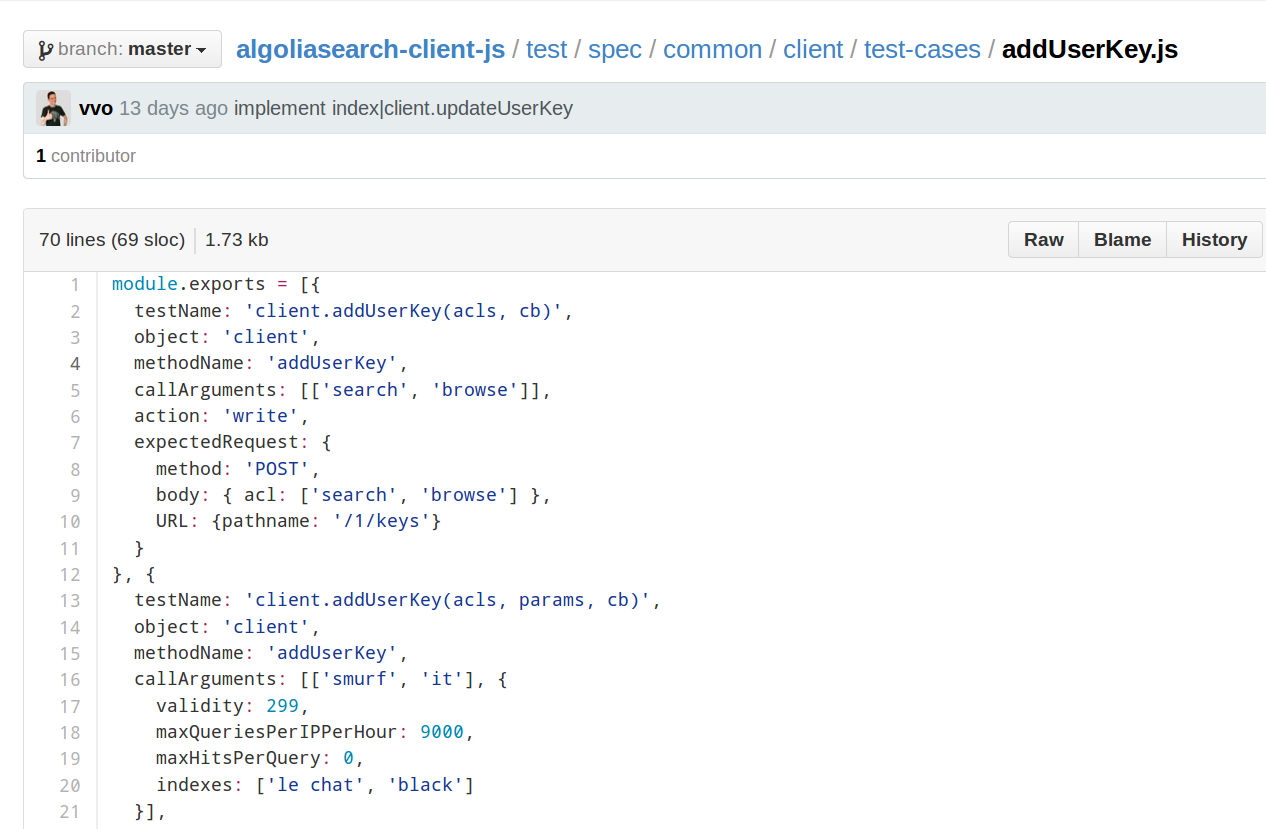
<p>Simple test cases were written as <a href="https://github.com/golang/go/wiki/TableDrivenTests">table driven
tests</a>:</p>

<p><a href="https://blog.algolia.com
/wp-content/uploads/2015/04/2015-04-27-161853_1266x829_scrot.png"><img src="assets/2015-04-27-161853_1266x829_scrot.png" alt="It's a simple
JavaScript file, exporting test cases as an
array" /></a> It’s a
simple JavaScript file, <a href="https://github.com/algolia/algoliasearch-client-
js/blob/1c8df9d09d683915a414e7df87a14236e50dd53c/test/spec/common/index/test-
cases/addUserKey.js#L1">exporting test cases as an
array</a></p>

<p>Creating a testing stack that understands theses test-cases was some work. But
the reward was worth it: the TDD feedback loop is great. Adding a new feature
is easy: fire editor, add test, implement annnnnd done.</p>

<h3 id="advanced-tests">Advanced tests</h3>

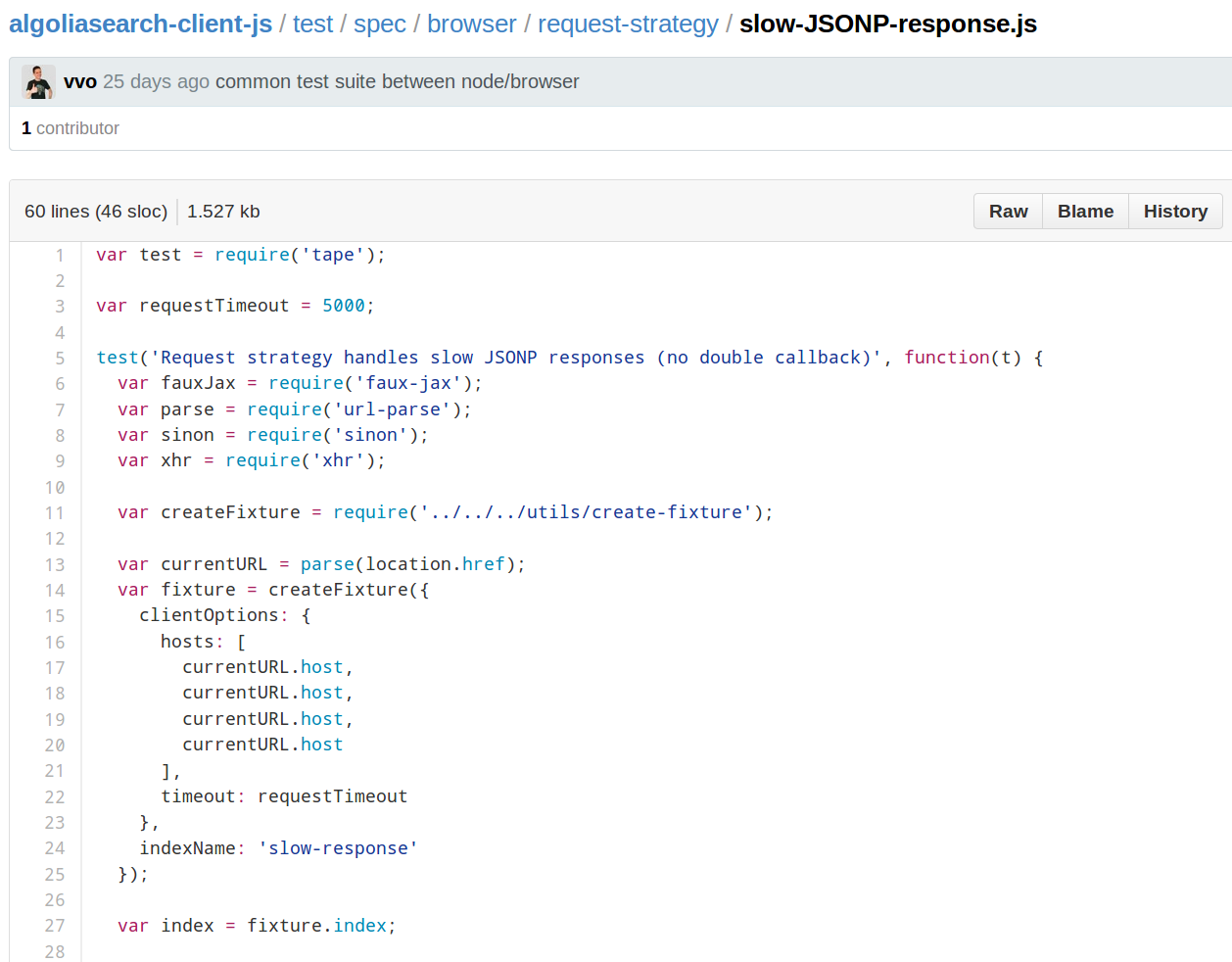
<p>Complex test cases like JSONP fallback, timeouts and errors, were handled in
separate, <a href="https://github.com/algolia/algoliasearch-
client-js/blob/1c8df9d09d683915a414e7df87a14236e50dd53c/test/spec/browser
/request-strategy/use-JSONP-when-XHR-error.js">more advanced tests</a>:</p>

<p><a href="https://blog.algolia.com/wp-content/uploads/2015/04/2015-04-27-162229_1258x982_scrot.png"><img src="assets/2015-04-27-162229_1258x982_scrot.png" alt="Our testing
stack rely on substack/tape" /></a> Here we test
that we are using JSONP when XHR fails</p>

<h2 id="testing-workflow">Testing workflow</h2>

<p>To be able to run our tests we chose
<a href="https://github.com/defunctzombie/zuul/">defunctzombie/zuul</a>.</p>

<h3 id="local-development">Local development</h3>

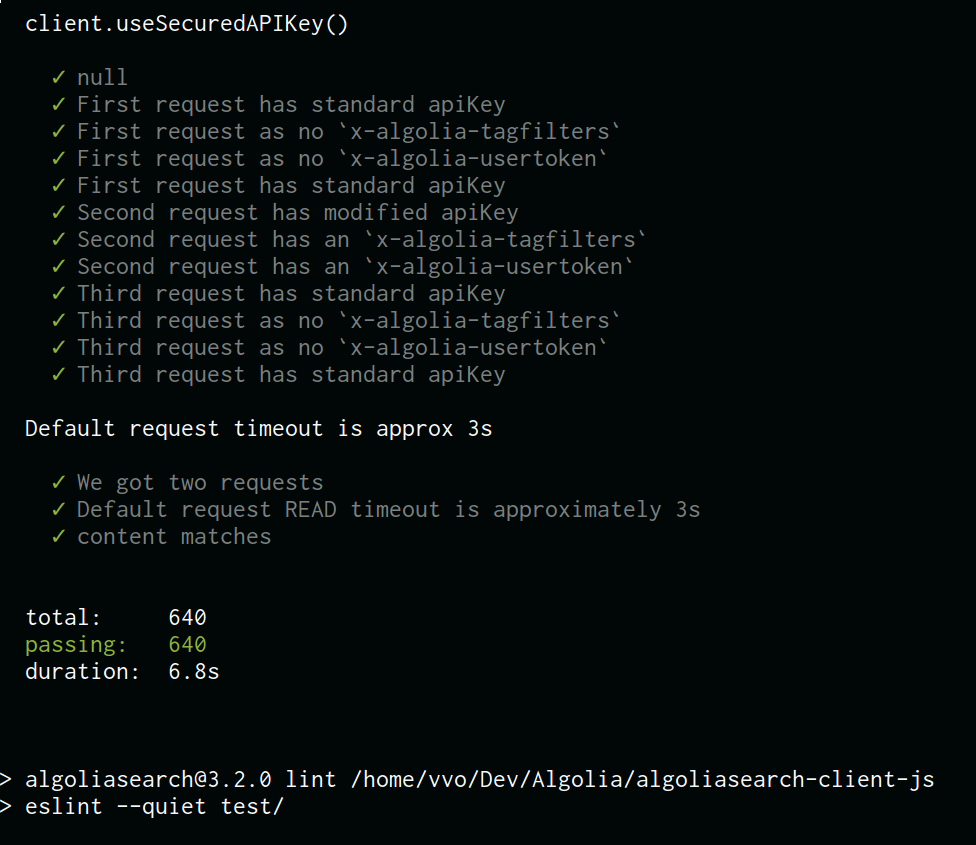
<p>For local development, we have an <strong>npm test</strong> task that will:</p>

<ul>
  <li>launch the browser tests using <a href="http://phantomjs.org/">phantomjs</a>,</li>
  <li>run the Node.js tests,</li>
  <li>lint using <a href="http://eslint.org/">eslint</a>.</li>
</ul>

<p>You can <a href="https://github.com/algolia/algoliasearch-client-
js/blob/1c8df9d09d683915a414e7df87a14236e50dd53c/package.json#L12">see the task</a> in the
package.json. Once run it looks like this:</p>

<p><a href="https://blog.algolia.com/wp-content/uploads/2015/04/2015-04-27-170339_976x845_scrot.png"><img src="assets/2015-04-27-170339_976x845_scrot.png" alt="640 passing
assertions and counting!" /></a> 640 passing
assertions and counting!</p>

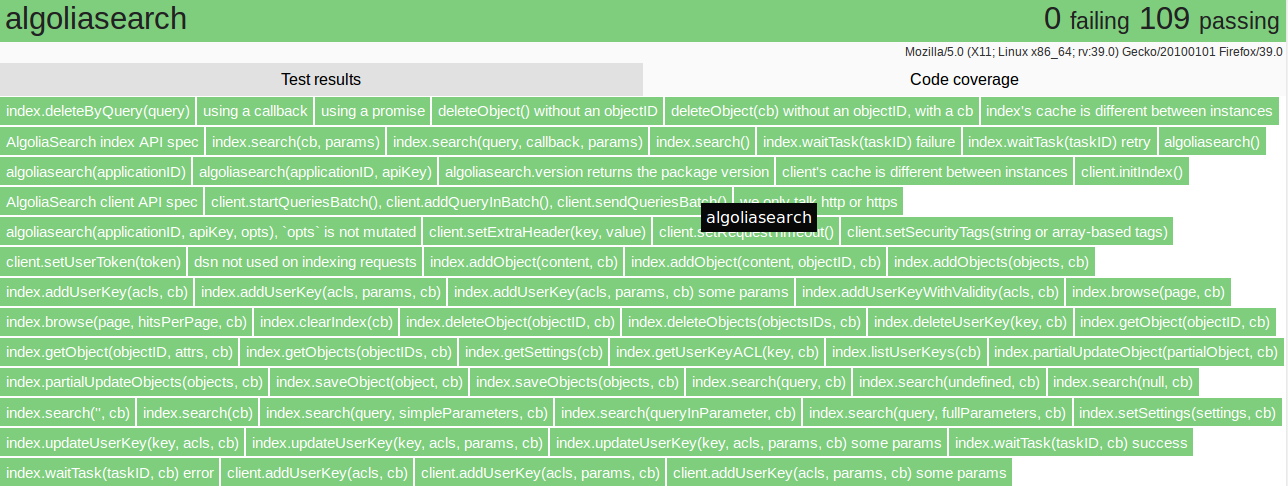
<p>But phantomjs is no real browser so it should not be the only answer to “Is my
module working in browsers?”. To solve this, we have an <a href="https://github.com/algolia/algoliasearch-client-
js/blob/1c8df9d09d683915a414e7df87a14236e50dd53c/package.json#L16">npm run
dev</a> task that
will expose our tests in a simple web server accessible by any browser:</p>

<p><a href="https://blog.algolia.com/wp-content/uploads/2015/04/2015-04-27-170757_1288x486_scrot.png"><img src="assets/2015-04-27-170757_1288x486_scrot.png" alt="All of theses
features are provided by defunctzombie/zuul" /></a> All of theses
features are provided by defunctzombie/zuul</p>

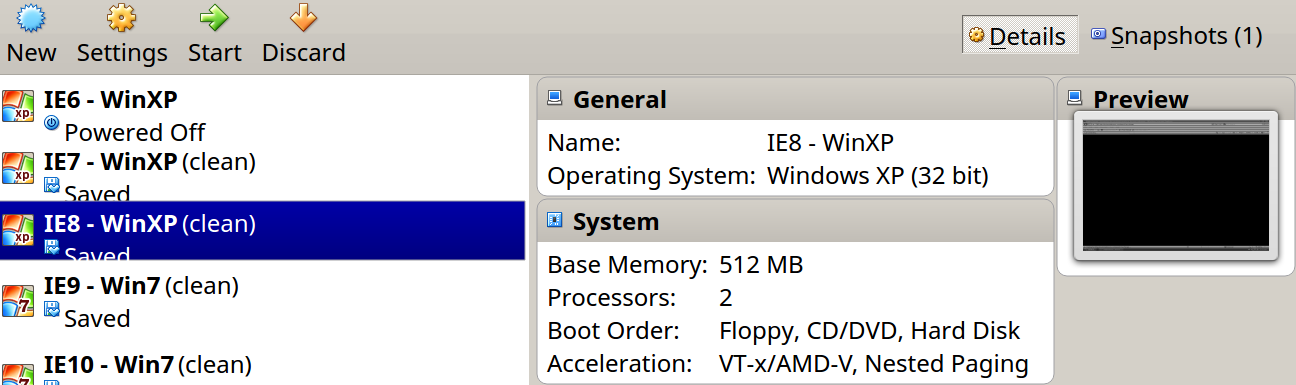
<p>Finally, if you have <a href="https://www.virtualbox.org/">virtual machines</a>, you can
test in any browser you want, all locally:</p>

<p><a href="https://blog.algolia.com/wp-content/uploads/2015/04/2015-04-27-171034_1296x385_scrot.png"><img src="assets/2015-04-27-171034_1296x385_scrot.png" alt="Here's a
VirtualBox setup created with xdissent/ievms" /></a> Here’s a
VirtualBox setup created with
<a href="https://github.com/xdissent/ievms">xdissent/ievms</a></p>

<p>What comes next after setting up a good local development workflow? Continuous
integration setup!</p>

<h3 id="continuous-integration">Continuous integration</h3>

<p><a href="https://github.com/defunctzombie/zuul/">defunctzombie/zuul</a> supports running
tests using <a href="https://saucelabs.com/">Saucelabs</a> browsers. Saucelabs provides
browsers as a service (manual testing or Selenium automation). It also has a
nice OSS plan called <a href="https://saucelabs.com/opensauce/">Opensauce</a>. We patched
our <a href="https://github.com/algolia/algoliasearch-client-
js/blob/1c8df9d09d683915a414e7df87a14236e50dd53c/.zuul.yml">.zuul.yml</a> configuration file
to specify what browsers we want to test. You can find all the details in
<a href="https://github.com/defunctzombie/zuul/wiki/Cloud-testing">zuul’s wiki</a>.</p>

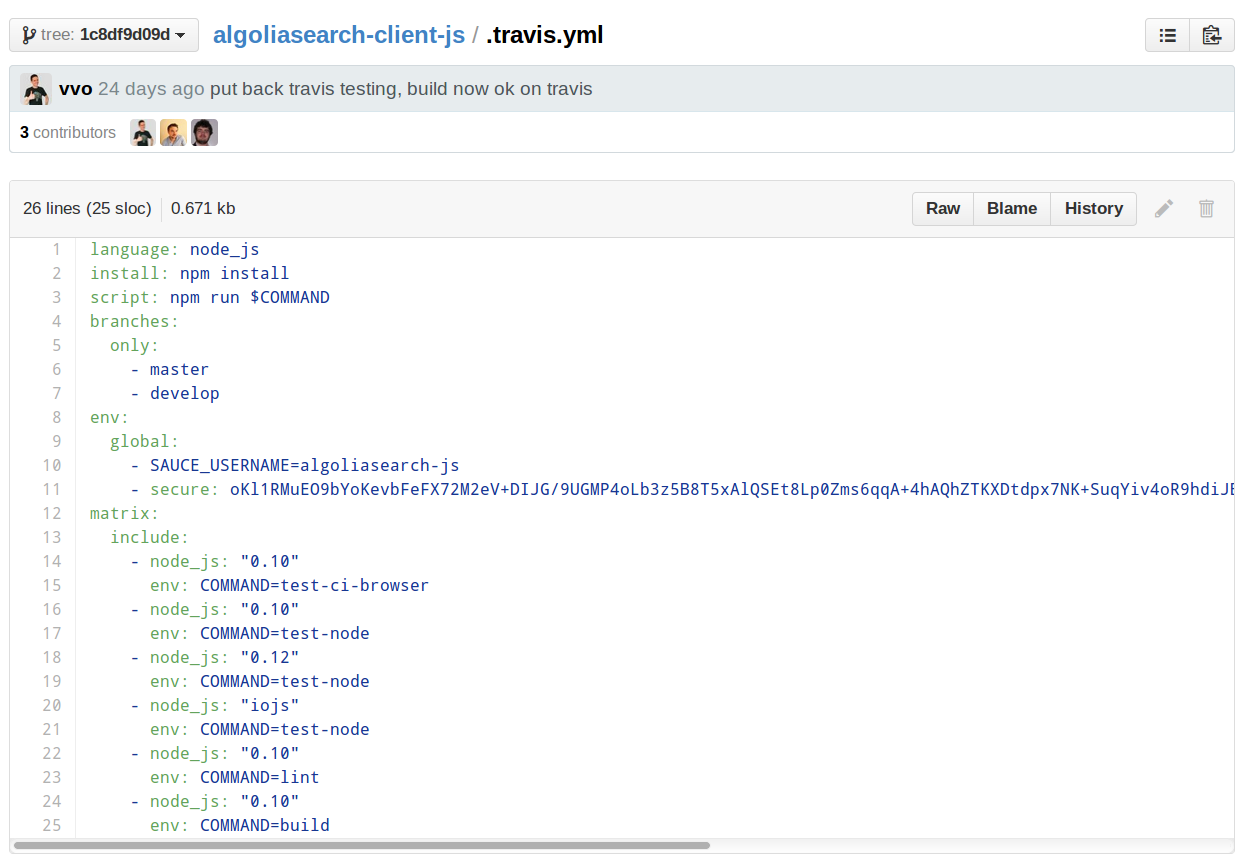
<p>Now there’s only one missing piece: <a href="https://travis-ci.org/">Travis CI</a>.
Travis runs our tests in all browsers defined in our .zuul.yml file. Our
<a href="https://github.com/algolia/algoliasearch-client-
js/blob/1c8df9d09d683915a414e7df87a14236e50dd53c/.travis.yml">travis.yml</a> looks like this:</p>

<p><a href="https://blog.algolia.com/wp-content/uploads/2015/04/2015-04-27-172249_1248x868_scrot.png"><img src="assets/2015-04-27-172249_1248x868_scrot.png" alt="All platforms are tested using travis
matrixes" />
</a>
All platforms are tested using a <a href="http://docs.travis-ci.com/user/build-configuration/#The-Build-Matrix">travis build
matrix</a></p>

<p>Right now tests are taking a bit too long so we will soon split them between
desktop and mobile.</p>

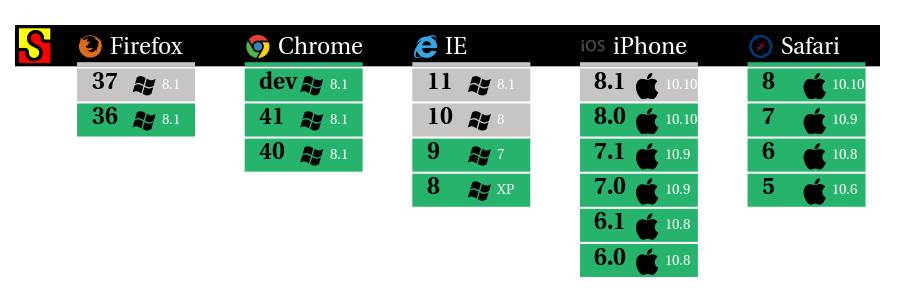
<p>We also want to to tests on pull requests using only latest stable versions of
all browsers. So that it does not takes too long. As a reward, we get a <a href="https://docs.saucelabs.com/reference/status-images/">nice
badge</a> to display in our
Github <a href="https://github.com/algolia/algoliasearch-client-js#algolia-
search-api-client-for-javascript">readme</a>:</p>

<p><a href="https://blog.algolia.com
/wp-content/uploads/2015/04/2015-04-27-174139_920x306_scrot.png"><img src="assets/2015-04-27-174139_920x306_scrot.png" alt="Gray color
means the test is currently
running" /></a> Gray color
means the test is currently running</p>

<h1 id="challenge-2-redesign-and-rewrite">Challenge #2: redesign and rewrite</h1>

<p>Once we had a usable testing stack, we started our rewrite, the <a href="https://github.com/algolia/algoliasearch-client-
js/issues?q=milestone%3AV3">V3
milestone</a> on Github.</p>

<h2 id="initialization">Initialization</h2>

<p>We dropped the <strong>new AlgoliaSearch()</strong> usage in favor of just
<strong>algoliasearch()</strong>. It allows us to hide implementation details to our API
users.</p>

<p>Before:</p>

<blockquote>
  <p>new AlgoliaSearch(applicationID, apiKey, opts);</p>
</blockquote>

<p>After:</p>

<blockquote>
  <p>algoliasearch(applicationID, apiKey, opts);</p>
</blockquote>

<h2 id="callback-convention">Callback convention</h2>

<p>Our JavaScript client now follows the <a href="http://fredkschott.com/post/2014/03/understanding-error-first-
callbacks-in-node-js/">error-
first</a> and <a href="http://blog.izs.me/post/59142742143
/designing-apis-for-asynchrony">callback-last</a> conventions. We had to break some methods to
do so.</p>

<p>Before:</p>

<blockquote>
  <p>client.method(param, callback, param, param);</p>
</blockquote>

<p>After:</p>

<blockquote>
  <p>client.method(params, param, param, params, callback);</p>
</blockquote>

<p>This allows our callback lovers to use libraries like
<a href="https://github.com/caolan/async">caolan/async</a> very easily.</p>

<h2 id="promises-and-callbacks-support">Promises and callbacks support</h2>

<p>Promises are a great way to handle the asynchronous flow of your application.</p>

<blockquote>
  <p>Promise partisan? Callback connoisseur? My API now lets you switch between
the two! <a href="http://t.co/uPhej2yAwF">http://t.co/uPhej2yAwF</a> (thanks
<a href="https://twitter.com/NickColley">@NickColley</a>!)</p>
</blockquote>

<blockquote>

</blockquote>

<blockquote>
  <p>— pouchdb (@pouchdb) <a href="https://twitter.com/pouchdb/status/575310959947956224">March 10,
2015</a></p>
</blockquote>

<p>We implemented both promises and callbacks, it was nearly a no-brainer. In
every command, if you do not provide a callback, you get a <a href="https://d
eveloper.mozilla.org/en/docs/Web/JavaScript/Reference/Global_Objects/Promise">Promise</a>.
We use native promises in <a href="http://caniuse.com/#feat=promises">compatible
environments</a> and
<a href="https://github.com/jakearchibald/es6-promise/">jakearchibald/es6-promise</a> as
a polyfill.</p>

<h2 id="algoliasearchhelper-removal">AlgoliaSearchHelper removal</h2>

<p>The main library was also previously exporting window.AlgoliaSearchHelper to
ease the development of awesome search UIs. We externalized this project and
it now has now has a new home at <a href="https://github.com/algolia/algoliasearch-helper-js">algolia/algoliasearch-helper-
js</a>.</p>

<h2 id="umd">UMD</h2>

<blockquote>
  <p>UMD: JavaScript modules that run anywhere</p>
</blockquote>

<p>The previous version was directly exporting multiple properties in the
<strong>window</strong> object. As we wanted our new library to be easily compatible with a
broad range of module loaders, we made it <a href="https://github.com/umdjs/umd">UMD</a>
compatible. It means our library can be used:</p>

<ul>
  <li>with a simple <code class="language-plaintext highlighter-rouge">&lt;script&gt;</code>, it will export <strong>algoliasearch</strong> in the <strong>window</strong> object</li>
  <li>using <a href="http://browserify.org/">browserify</a>, <a href="http://webpack.github.io/">webpack</a>, <a href="http://requirejs.org/">requirejs</a>: any module loader</li>
  <li>in <a href="https://nodejs.org/">Node.js</a></li>
</ul>

<p>This was achieved by writing our code in a
<a href="http://en.wikipedia.org/wiki/CommonJS">CommonJS</a> style and then use the
standalone build feature of browserify.</p>

<p><a href="https://blog.algolia.com/wp-content/uploads/2015/04/2015-04-28-224616_1126x129_scrot.png"><img src="assets/2015-04-28-224616_1126x129_scrot.png" alt="see browserify
usage" /></a> see
<a href="https://github.com/substack/node-
browserify#usage">browserify usage</a></p>

<h2 id="multiple-builds">Multiple builds</h2>

<p>Our JavaScript client isn’t only one build, we have multiple builds:</p>

<ul>
  <li>vanilla JavaScript using native xhrs and Promises</li>
  <li>jQuery build using <a href="http://api.jquery.com/jquery.ajax/">jQuery.ajax</a> and returns <a href="https://api.jquery.com/category/deferred-object/">jQuery promises</a></li>
  <li>AngularJS build is using <a href="https://docs.angularjs.org/api/ng/service/$http">$http</a> service and returns <a href="https://docs.angularjs.org/api/ng/service/$q">AngularJS promises</a></li>
  <li><a href="https://parse.com/">Parse.com</a> build is using parse cloud <a href="https://parse.com/docs/cloud_code_guide#networking">http</a> and <a href="https://parse.com/docs/js_guide#promises">promises</a></li>
  <li>Node.js, iojs are using the <a href="https://nodejs.org/api/http.html">http module</a> and native Promises</li>
</ul>

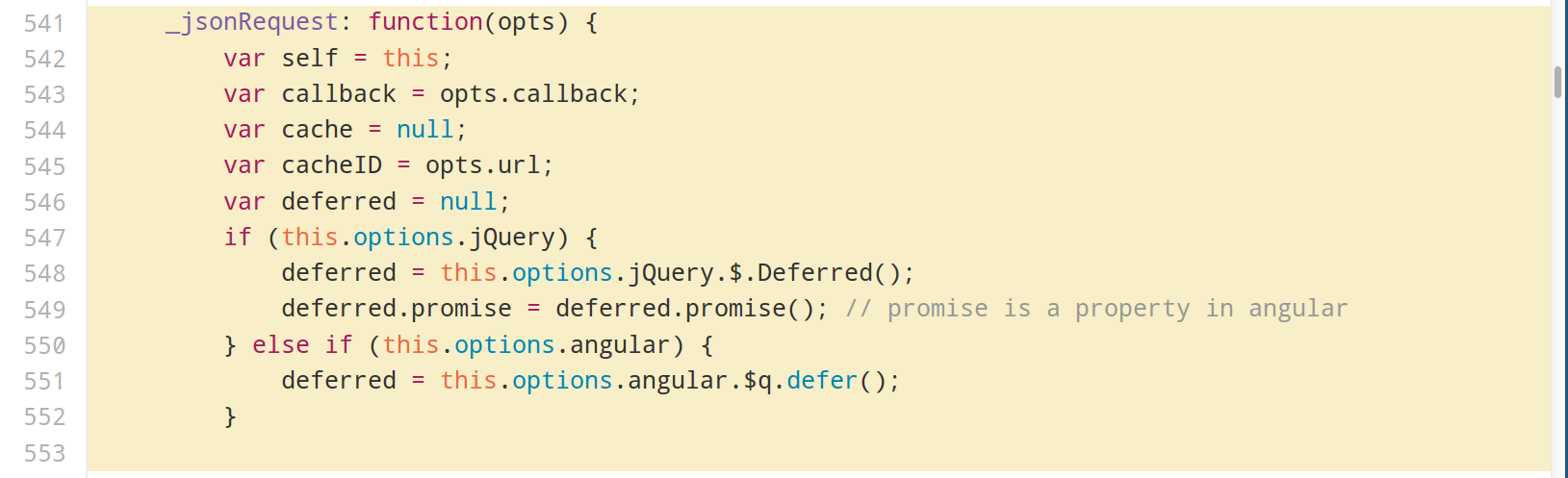
<p>Previously this was all handled in the main JavaScript file, leading to unsafe
<a href="https://github.com/algolia/algoliasearch-client-js/blob/ba71a
68005945c73f7157a8222a9c758e332eceb/src/algoliasearch.js#L541-L553">code like this</a>:</p>

<p><a href="https://blog.algolia.com/wp-content/uploads/2015/04/2015-04-28-225743_1629x497_scrot.png"><img src="assets/2015-04-28-225743_1629x497_scrot.png" alt="2015-04-28-225743_1629x497_scrot" /></a></p>

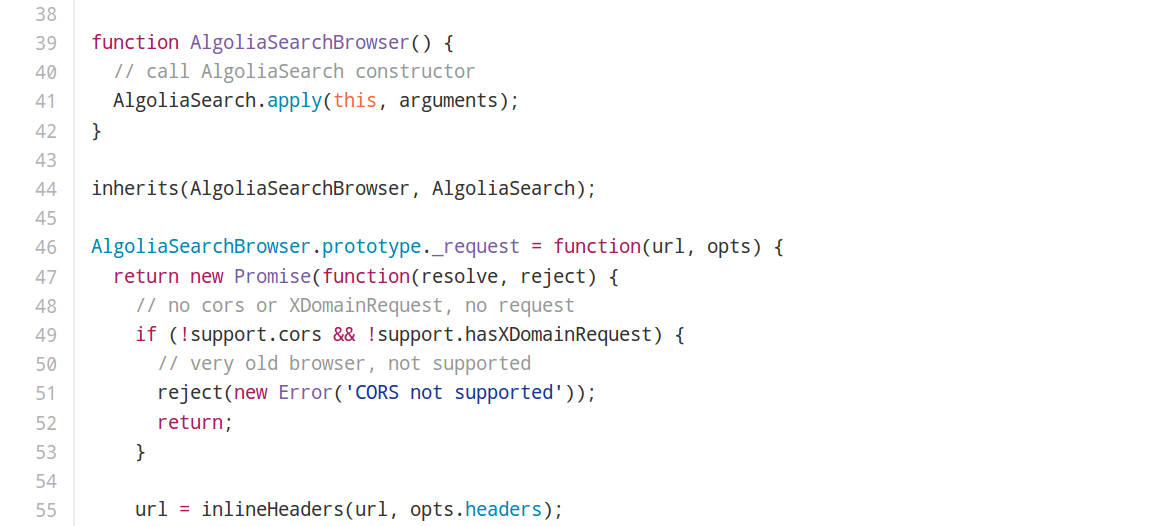
<p>How do we solve this? Using inheritance! JavaScript prototypal inheritance is
the new code smell in 2015. For us it was a good way to share most of the code
between our builds. As a result every entry point of our builds are inheriting
from the <a href="https://github.com/algolia/algoliasearch-
client-js/blob/1c8df9d09d683915a414e7df87a14236e50dd53c/src/AlgoliaSearch.js">src/AlgoliaSearch.js</a>.</p>

<p>Every build then need to define how to:</p>

<ul>
  <li>do http request through <a href="https://github.com/algolia/algoliasearch-client-js/blob/1c8df9d09d683915a414e7df87a14236e50dd53c/src/browser/builds/algoliasearch.js#L46-L150">AlgoliaSearch.prototype._request</a></li>
  <li>return promises with <a href="https://github.com/algolia/algoliasearch-client-js/blob/1c8df9d09d683915a414e7df87a14236e50dd53c/src/browser/builds/algoliasearch.js#L167-L179">AlgoliaSearch.prototype._promise</a></li>
  <li>use a request fallback where needed with <a href="https://github.com/algolia/algoliasearch-client-js/blob/1c8df9d09d683915a414e7df87a14236e50dd53c/src/browser/builds/algoliasearch.js#L152-L165">AlgoliaSearch.prototype._request.fallback</a></li>
</ul>

<p>Using a simple inheritance pattern we were able to solve a great challenge.</p>

<p><a href="https://blog.algolia.com
/wp-content/uploads/2015/04/2015-04-28-232019_1153x526_scrot.png"><img src="assets/2015-04-28-232019_1153x526_scrot.png" alt="Example of the
vanilla JavaScript
build" /></a> Example of
the vanilla JavaScript build</p>

<p>Finally, we have <a href="https://github.com/algolia/algoliasearch-
client-js/blob/1c8df9d09d683915a414e7df87a14236e50dd53c/scripts/build">a build script</a> that
will generate all the needed files for each environment.</p>

<h2 id="challenge-3-backward-compatibility">Challenge #3: backward compatibility</h2>

<p>We could not completely modernize our JavaScript clients while keeping a full
backward compatibility between versions. We had to break some of the previous
usages to level up our JavaScript stack.</p>

<p>But we also wanted to provide a good experience for our previous users when
they wanted to upgrade:</p>

<ul>
  <li>we re-exported previous constructors like window.AlgoliaSearch*. But we now <strong>throw</strong> if it’s used</li>
  <li>we wrote a clear <a href="https://github.com/algolia/algoliasearch-client-js/wiki/Migration-guide-from-2.x.x-to-3.x.x">migration guide</a> for our existing Node.js and JavaScript users</li>
  <li>we used <a href="https://docs.npmjs.com/cli/deprecate">npm deprecate</a> on our previous Node.js module to inform our current user base that we moved to a new client</li>
  <li>we created legacy branches so that we can continue to push critical updates to previous versions when needed</li>
</ul>

<h2 id="make-it-isomorphic">Make it isomorphic!</h2>

<p>Our final step was to make our JavaScript client work in both Node.js and the
browser.</p>

<p>Having separated the builds implementation helped us a lot, because the
Node.js build is a regular build only using the http module from Node.js.</p>

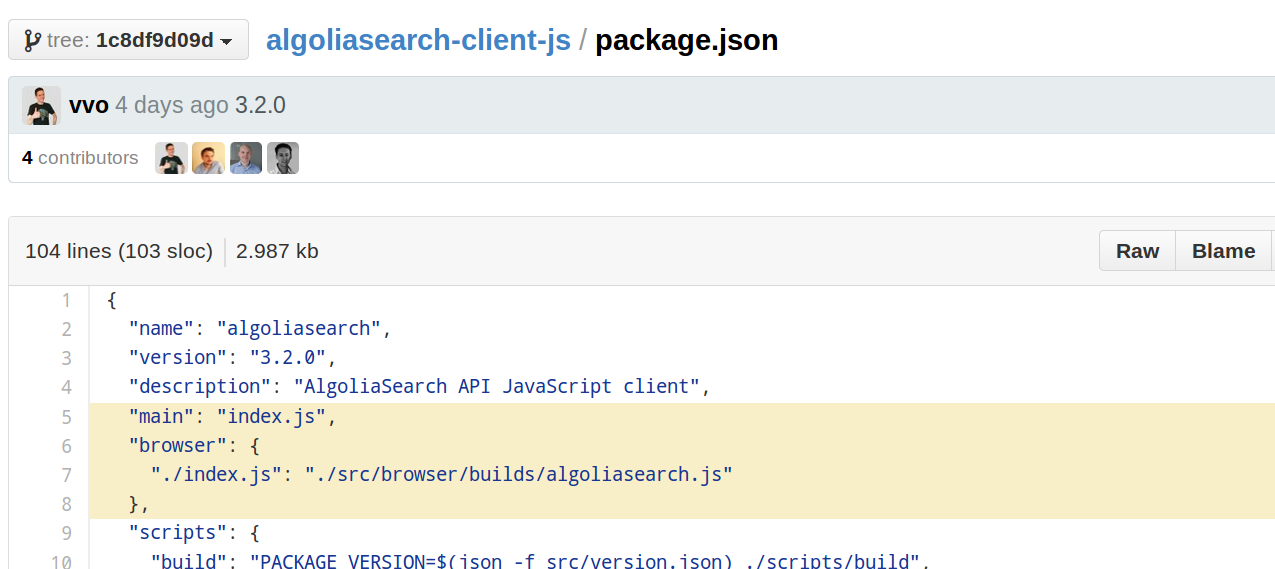
<p>Then we only had to tell module loaders to load <strong>index.js</strong> on the server and
<strong>src/browser/..</strong> in browsers.</p>

<p>This last step was done by configuring browserify in <a href="https://github.com/algolia/algoliasearch-client-
js/blob/1c8df9d09d683915a414e7df87a14236e50dd53c/package.json#L5-L8">our
package.json</a>:</p>

<p><a href="https://blog.algolia.com/wp-content/uploads/2015/04/2015-04-28-232444_1275x569_scrot.png"><img src="assets/2015-04-28-232444_1275x569_scrot.png" alt="the browser field from browserify also works in webpack" /></a> the <a href="https://github.com/substack/node-browserify#browser-field">browser
field</a> from
browserify also works in webpack</p>

<p>If you are using the <strong>algoliasearch</strong> module with browserify or webpack, you
will get our browser implementation automatically.</p>

<p>The <strong>faux-jax</strong> library is released under MIT like all our open source
projects. Any feedback or improvement idea are welcome, we are dedicated to
make our JS client your best friend :)</p>]]></content><author><name>Vincent</name></author><summary type="html"><![CDATA[Algolia’s DNA is really about performance. We want our search engine to answer relevant results as fast as possible.]]></summary></entry><entry><title type="html">Quadrant.io solves the frustration of economic data search with Algolia</title><link href="/jekyll-algolia-example/2015/04/20/quadrant-io-solves-the-frustration-of-economic-data-search-with-algolia.html" rel="alternate" type="text/html" title="Quadrant.io solves the frustration of economic data search with Algolia" /><published>2015-04-20T00:00:00+00:00</published><updated>2015-04-20T00:00:00+00:00</updated><id>/jekyll-algolia-example/2015/04/20/quadrant-io-solves-the-frustration-of-economic-data-search-with-algolia</id><content type="html" xml:base="/jekyll-algolia-example/2015/04/20/quadrant-io-solves-the-frustration-of-economic-data-search-with-algolia.html"><![CDATA[<p>Browsing the cumbersome interfaces of government websites in the lookout for
reliable data can be a very frustrating experience. It’s full of specific
terminology and there’s not a government website that looks the same. It’s
like each time you want to use a car, you have to learn to drive all over
again.</p>

<h2 id="connect-ideas-with-economic-insight-in-a-matter-of-seconds">Connect ideas with economic insight in a matter of seconds</h2>

<p>That’s what <a href="https://www.quadrant.io/find/#/search">Quadrant.io</a> is for.
Solving the frustration anyone who makes their points with facts encounters
when routinely performing data search. It offers them with the fastest and
easiest way to find and chart economic data from trusted sources.
Acknowledging that it can quickly become a nightmare to find reliable
information scattered all over the web,
<a href="https://www.quadrant.io/find/#/search">Quadrant</a> is on a mission to <strong>shorten
any data search to seconds</strong>. <strong>So that data users can spend less time finding
data and more time analysing it.</strong></p>

<p>To keep this promise, Quadrant provides data users with an intuitive platform
that aggregates more than 400,000 indicators from over 1,000 public sources,
and keep them updated in real time. <strong>A powerful search allowing any user to
find exactly what they are looking for even if they do not use economists’
jargon</strong> is a must-have functionality in such a service.</p>

<p>And Algolia stood out as the perfect search solution for Quadrant.</p>

<h2 id="provide-a-rewarding-search-experience-to-end-users">Provide a rewarding search experience to End-Users</h2>

<p>First because of** the rewarding search experience it allows to deliver to its
users.**</p>

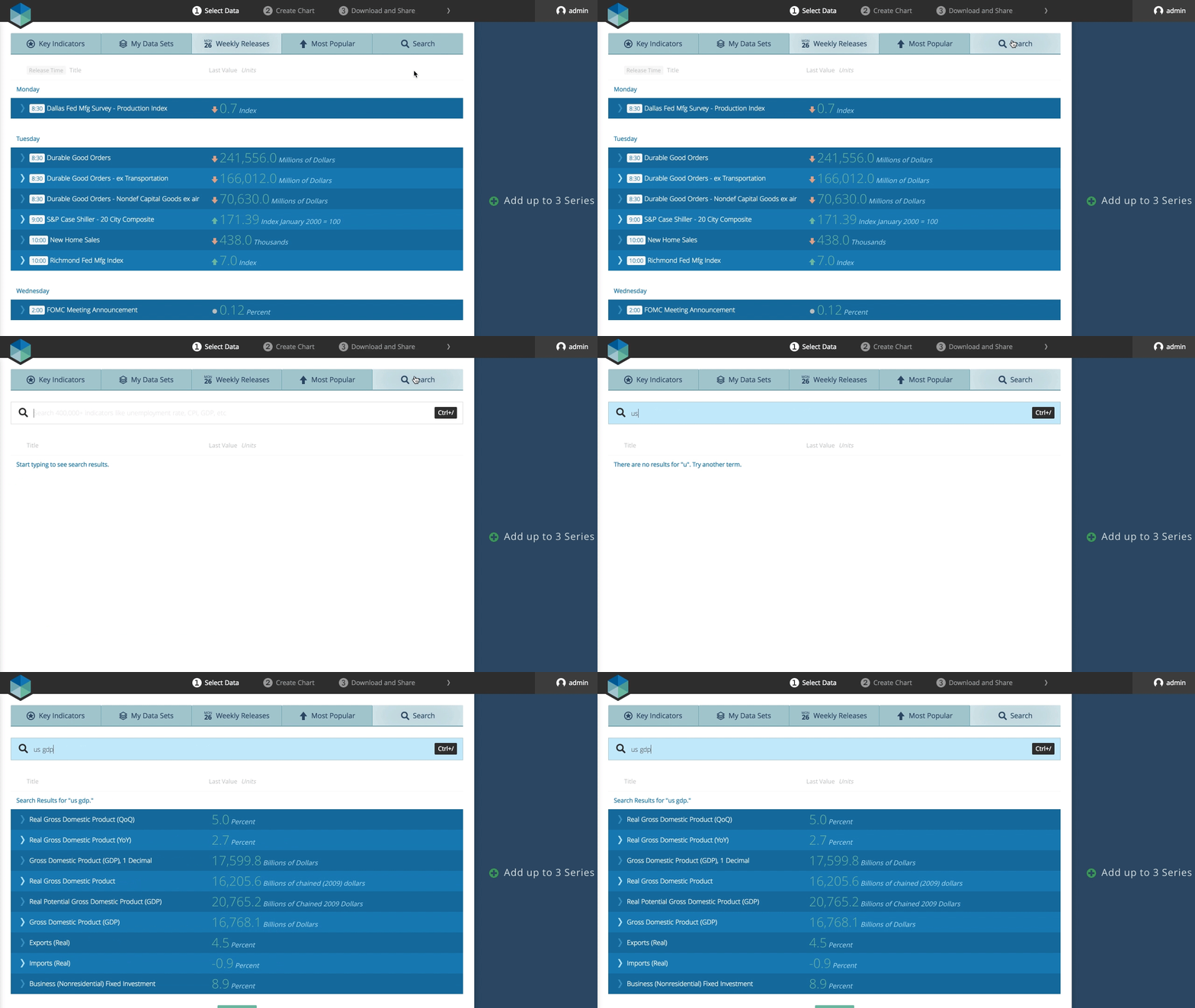
<p>Algolia surfaces data relevant to people’s search in milliseconds, showing the
most appropriate results from the very first keystroke.</p>

<p><img src="./assets/searchquadrant1.gif" alt="searchquadrant1" /></p>

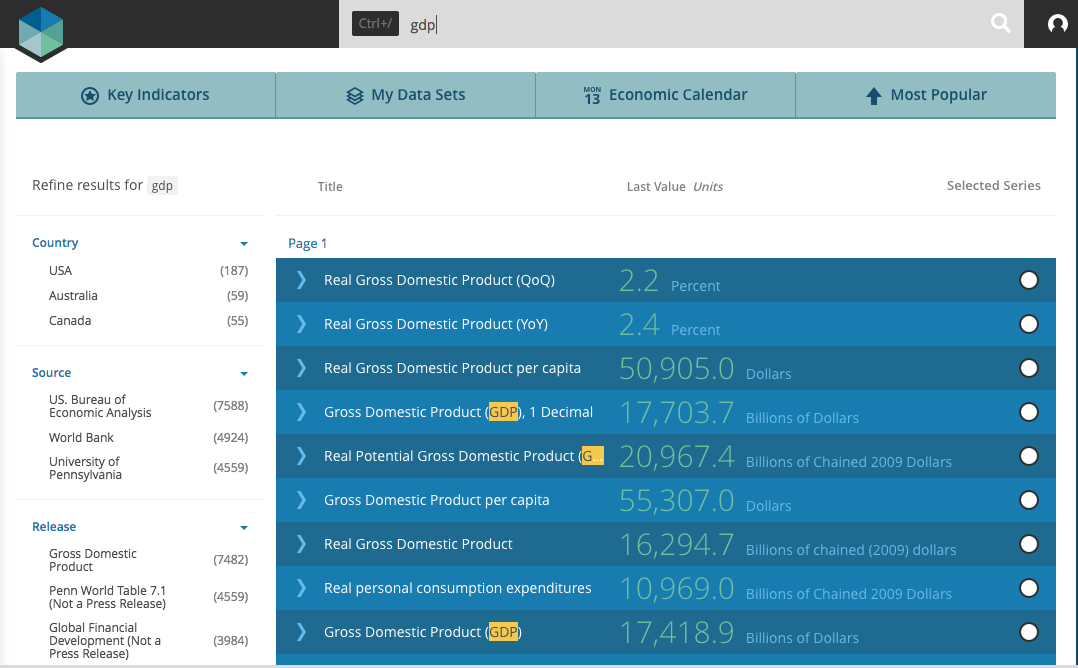
<p>It enables to search across different entry points corresponding to the
different attributes describing data series (release date, source).</p>

<p><img src="./assets/Screen-Shot-2015-04-13-at-18.06.28.png" alt="Screen-Shot-2015-04-13-at-18.06.28" /></p>

<p>That wasn’t possible with other search solutions they tested before. After
implementing Algolia, Quadrant.io received nice feedback from their customers,
saying that “search was much more comfortable, much more intuitive”.</p>

<h2 id="algolia-empowers-anyone-to-be-a-search-expert">Algolia empowers anyone to be a search expert</h2>

<p>Second, because of the simple experience it is to deploy Algolia on their web
app. Back-end documentation and customer support was a major help: it took
them <strong>less than a week to implement instant search</strong>, including relevance
tweaking and front-end development. As Dane Vrabrac, co-founder of Quadrant.io
concluded “with Algolia, it’s awesome all the stuff I can do as a non
developer !”</p>

<p><em>Images courtesy of Quadrant.io. Learn more on their
<a href="https://quadrant.io/">website</a>.</em></p>]]></content><author><name>Marie-Auxille</name></author><summary type="html"><![CDATA[Browsing the cumbersome interfaces of government websites in the lookout for reliable data can be a very frustrating experience. It’s full of specific terminology and there’s not a government website that looks the same. It’s like each time you want to use a car, you have to learn to drive all over again.]]></summary></entry><entry><title type="html">Don’t let network latency ruin the search experience of your international users</title><link href="/jekyll-algolia-example/2015/02/18/distributed-search-network-latency-ruins-search-experience.html" rel="alternate" type="text/html" title="Don’t let network latency ruin the search experience of your international users" /><published>2015-02-18T00:00:00+00:00</published><updated>2015-02-18T00:00:00+00:00</updated><id>/jekyll-algolia-example/2015/02/18/distributed-search-network-latency-ruins-search-experience</id><content type="html" xml:base="/jekyll-algolia-example/2015/02/18/distributed-search-network-latency-ruins-search-experience.html"><![CDATA[<p>At Algolia, we allow developers to provide a unique interactive search
experience with as-you-type search, instant faceting, mobile geo-search and on
the fly spell check.</p>

<p>Our Distributed Search Network aims at removing the impact of network latency
on the speed of search, allowing our customers to offer this instant
experience to all their end-users, wherever they may be.</p>

<h2 id="every-millisecond-matters">Every millisecond matters</h2>

<p>We are obsessed with speed and we’re not the only ones: Amazon found out that
100ms in added latency cost them 1% in sales. <a href="http://glinden.blogspot.fr/2006/11/marissa-mayer-at-web-20.html">The lack of responsiveness for
a search engine can really be damaging for one’s
business</a>. As
individuals, we are all spoiled when it comes to our search expectations:
Google has conditioned the whole planet to expect instant results from
anywhere around the world.</p>

<p><img src="./assets/user-experience.jpg" alt="user-experience" /></p>

<p>We have the exact same expectations with any online service we use. The thing
is that for anyone who is not Google, <strong>it is just impossible to meet these
expectations</strong> because of the network latency due to the physical distance
between the service backend that hosts the search engine and the location of
the end-user.</p>

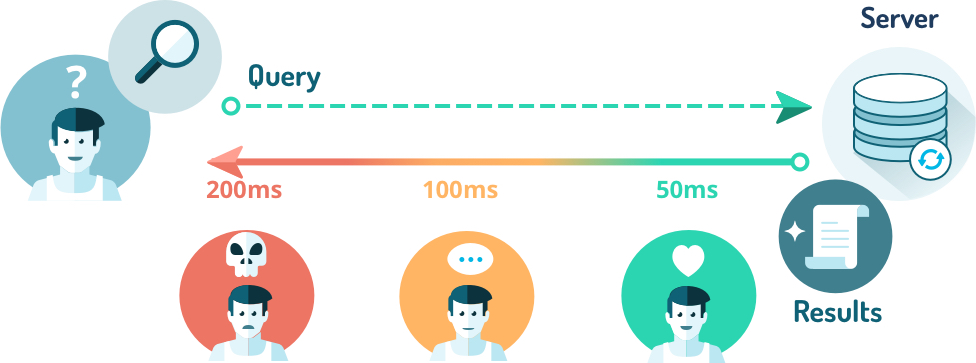
<p>Even with the fastest search engine in the world, it can still take hundreds
of milliseconds for a search result to reach Sydney from San Francisco. And
this is without counting the bandwidth limitations of a saturated oversea
fiber!</p>

<h2 id="how-we-beat-the-speed-of-light">How we beat the speed of light</h2>

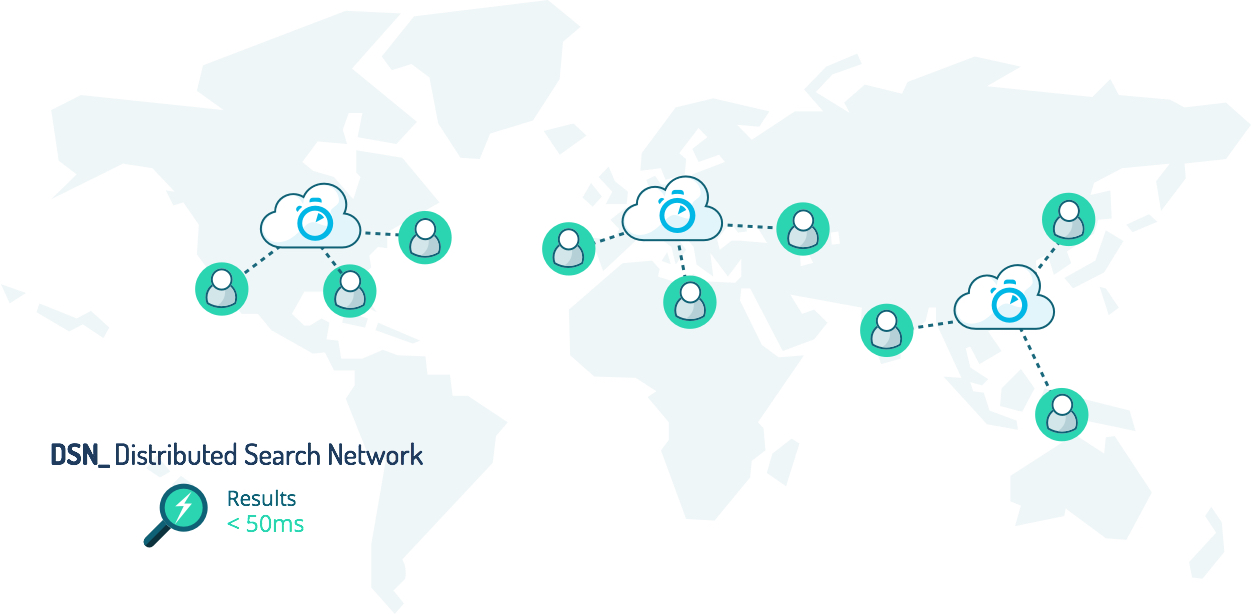
<p>Algolia’s Distributed Search Network (DSN) removes the latency from the speed
equation by <strong>replicating your indices to different regions around the world,
where your users are</strong>.</p>

<p>Your local search engines are clones synchronized across the world. DSN allows
you to <strong>distribute your search among 12 locations</strong> including the US,
Australia, Brazil, Canada, France, Germany, Hong Kong, India, Japan, Russia,
and Singapore. Thanks to our 12 data centers, your search engine can now
<strong>deliver search results under 50ms in the world’s top markets</strong>, ensuring an
optimal experience for all your users.</p>

<p><img src="./assets/DSN-b3ce122c790c492c2f2c8ddbabaae464.jpg" alt="DSN-b3ce122c790c492c2f2c8ddbabaae464" /></p>

<h2 id="how-you-activate-dsn">How you activate DSN</h2>

<p>Today, DSN is only accessible to our Starter, Growth, Pro and Enterprise plan
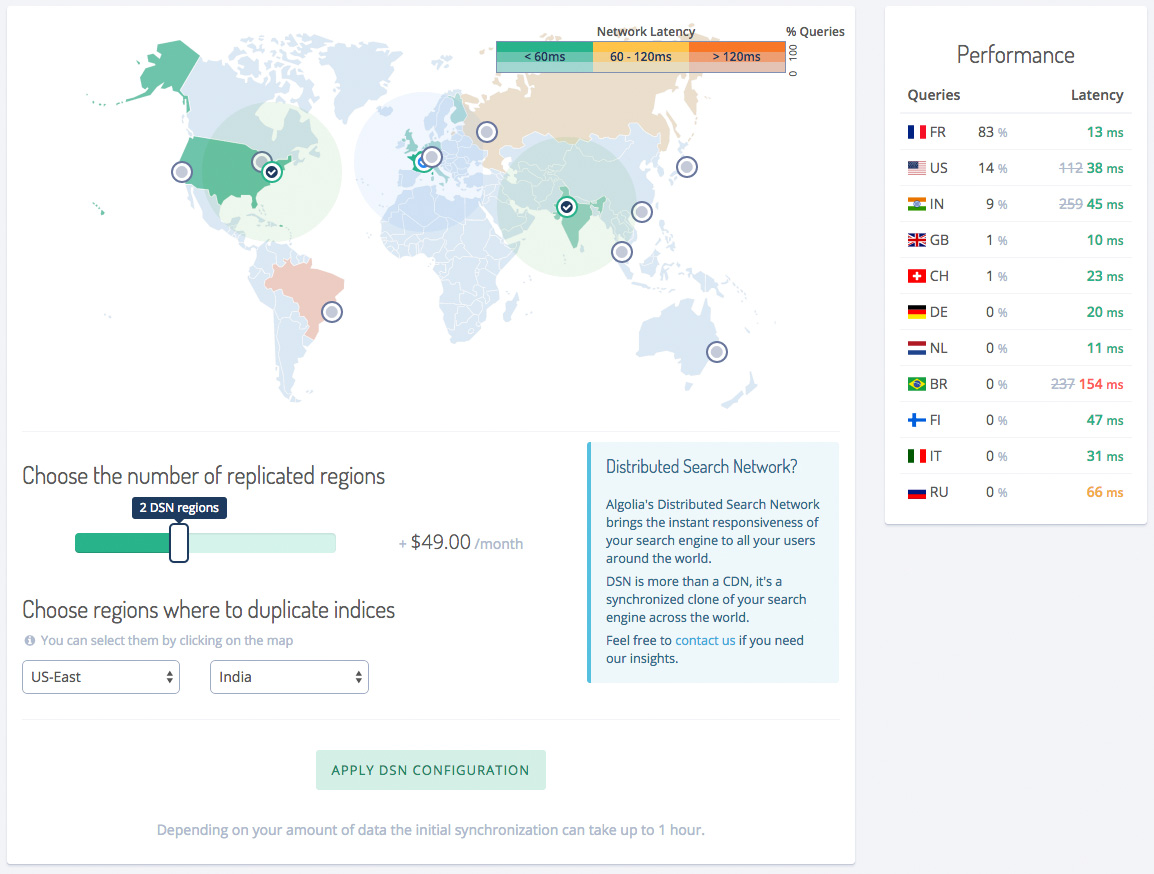
customers. To activate it, you simply need to go in the <strong>“Region” tab at the
top of your Algolia dashboard and select “Setup DSN”</strong>.</p>

<p><a href="https://www.algolia.com/dsn/setup"><img src="./assets/shot.jpg" alt="shot" /></a></p>

<p>You will then be displayed with a map and a selection of your top countries in
terms of search traffic. Just <strong>select our DSN data centers on the map and see
how performance in those countries is optimized</strong>.</p>

<p>Algolia will then automatically take care of the distribution and the
synchronization of your indices around the world. End-users’ queries will be
automatically routed to the closest data center among those you’ve selected,
ensuring the best possible experience. Algolia DSN delivers an ultra low
response time and automatic fail-over on another region if a region is down.</p>

<p><a href="https://www.algolia.com/dsn/setup"><img src="./assets/dsn-shot.jpg" alt="" /></a></p>

<p>It is that simple!</p>

<p>Today, several services including HackerNews, TeeSpring, Product Hunt and
Zendesk are leveraging <strong>Algolia DSN to provide faster search to their global
users</strong>.</p>

<p>Want to find out more about the Algolia experience ?</p>

<p><a href="https://www.algolia.com/features">Discover and try it here</a>!</p>]]></content><author><name>Marie-Auxille</name></author><summary type="html"><![CDATA[At Algolia, we allow developers to provide a unique interactive search experience with as-you-type search, instant faceting, mobile geo-search and on the fly spell check.]]></summary></entry><entry><title type="html">New experimental version of Hacker News Search built with Algolia</title><link href="/jekyll-algolia-example/2015/01/12/try-new-experimental-version-hn-search.html" rel="alternate" type="text/html" title="New experimental version of Hacker News Search built with Algolia" /><published>2015-01-12T00:00:00+00:00</published><updated>2015-01-12T00:00:00+00:00</updated><id>/jekyll-algolia-example/2015/01/12/try-new-experimental-version-hn-search</id><content type="html" xml:base="/jekyll-algolia-example/2015/01/12/try-new-experimental-version-hn-search.html"><![CDATA[<p>Exactly a year ago, we began to power the Hacker News search engine (see our
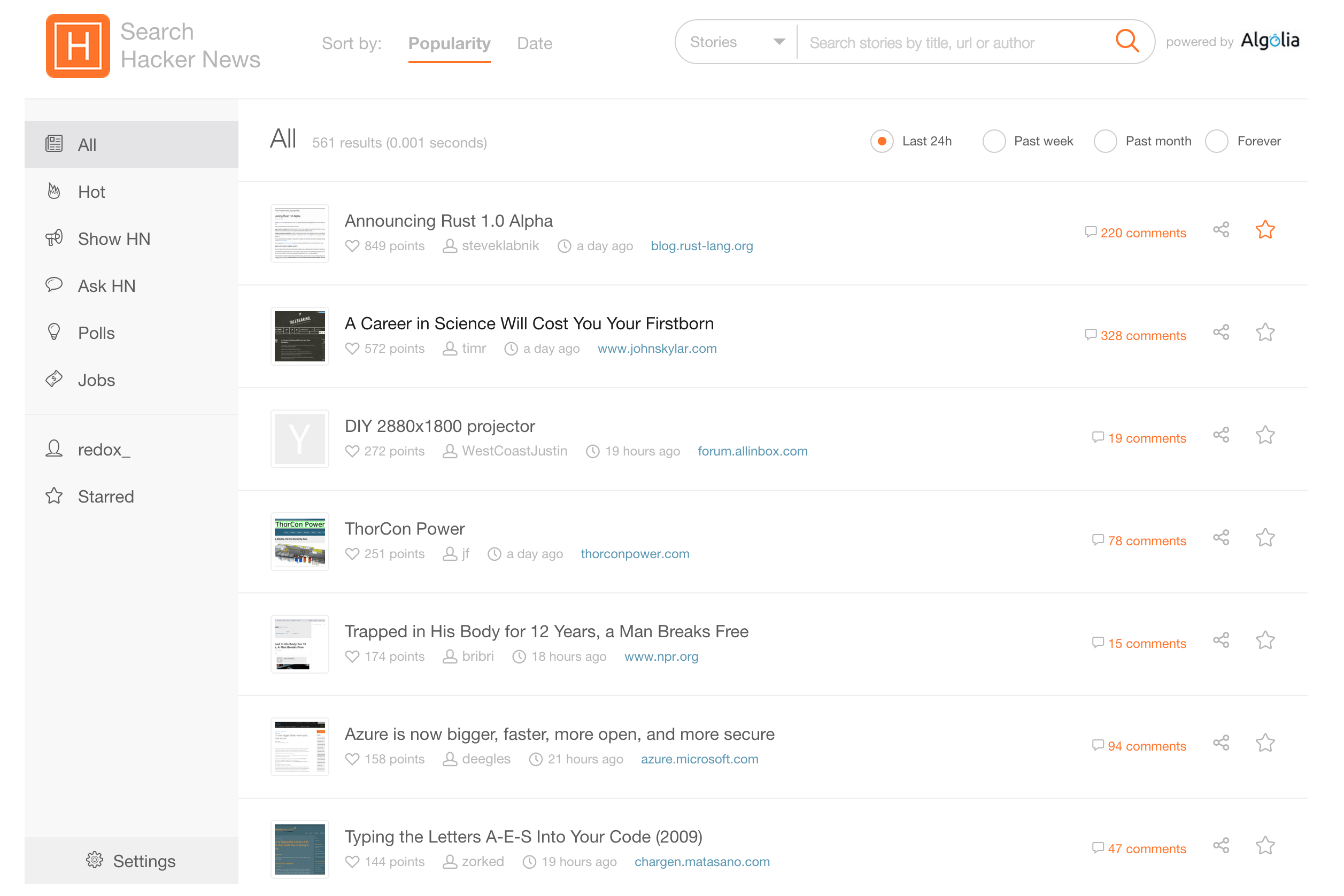
<a href="http://blog.algolia.com/hacker-news-search-algolia/)">blog post</a>. Since then,
our HN search project has grown a lot, expanding <strong>from 20M to 25M indexed
items</strong>, and serving** from 900K to 30M searches a month**.</p>

<p>In addition to <a href="http://hn.algolia.com">hn.algolia.com</a> we’re also providing</p>

<p>build various readers or monitor tools and we love the applications you’re
building on top of us. The community was also pretty active on
<a href="https://github.com/algolia/hn-search/issues">GitHub</a>, requesting improvements
and catching bugs… keep on contributing!</p>

<h2 id="eating-our-own-dog-food-on-hn-search">Eating our own dog food on HN search</h2>

<p>We are <strong>power users of Hacker News</strong> and there isn’t a single day we don’t
use it. Being able to use our own engine on a tool that is so important to us
has been a unique opportunity to <strong>eat our </strong><strong>own dog food.</strong> We’ve added a
lot of API features during the year but unfortunately didn’t have the time to
refresh the UI so far.</p>

<p>One of our 2015 resolutions was to push the envelope of the HN search UI/UX:</p>

<ul>
  <li>make it more <strong>readable</strong>,</li>
  <li>more <strong>usable</strong>,</li>
  <li>and use <strong>modern</strong> frontend frameworks.</li>
</ul>

<p>That’s what motivated us to release a <a href="https://new-hn.algolia.com/?experimental">new experimental version of HN
Search</a>. Try it out and tell us what
you think!</p>

<h2 id="applying-more-ui-best-practices">Applying more UI best practices</h2>

<p>We’ve learned a lot of things from the
<a href="https://news.ycombinator.com/item?id=7451206">comments</a> of the users of the
previous version. We also took a look at all the <a href="http://hn.algolia.com/cool_apps">cool
apps</a> built on top of our API. We wanted to
apply more UI best practices and here is what we ended with:</p>

<p><img src="./assets/hackpad.com_JoORx6jqcVU_p.233467_1420906940736_Screen%20Shot%202015-01-10%20at%2017.22.06.png" alt="" /></p>

<h3 id="focus-on-instantaneity">Focus on instantaneity</h3>

<p>The whole layout has been designed to provide an instant experience, reducing
the wait time before the actual content is displayed. It’s also a way to
reduce the number of mouse clicks needed to access and navigate through the
content. The danger with that kind of structure can be to end up with a
flickering UI where each user action redraw the page, activating unwanted
behaviors and consuming a huge amount of memory.We focused on a smooth
experience. Some of the techniques used are based on basic performance
optimizations but in the end what really matters for us is the user’s
perception of latency between each interactions, more than objective
performance. Here are some of the tricks we applied:</p>

<ul>
  <li><strong>Toggle comments</strong>: we wanted the user to be able to read all the comments of a story on the same page, our API on top of Firebase allowed us to load and display them with a single call.</li>
  <li><strong>Sticky posts</strong>: in some cases we are loading up to 500 comments, we wanted the user to be able to keep the information of what he is reading and easily collapse it, so we decided to keep the initial post on top of the list.</li>
  <li><strong>Lazy-loading of non-cached images</strong>: when you are refreshing the UI for each request you don’t want every thumbnail to flick on the UI when loading. So we applied a simple fade to avoid that. But there is actually no way to know if an image is already loaded or not from a previous query. We manage to detect that with a small timeout.</li>
  <li><strong>Loading feedback</strong>: the most important part of a reactive UI is to always give the user a feedback on the state of the UI. We choose to add this information with a thin loading bar on top of the page.</li>
  <li><strong>Deferring the load of some unnecessary elements</strong>: this one is about performance. When you are displaying about 20 repeatable items on each keypress you want them as light as possible. In our case we are using Angular.js with some directives which were too slow to render. So we ended up rendering them only if the user interact with them.</li>
  <li><strong>Cache every requests</strong>: It’s mainly about the backspace key. When a user want to modify his query by removing some characters you don’t want to make him wait for the result: that’s cached by the Algolia JS API client.</li>
</ul>

<h3 id="focus-on-readability">Focus on readability</h3>

<p>We’ve learned a lot from your comments while releasing our first HN Search
version last year. Readability of the search results must be outstanding to
allow you to quickly understand why the results are retrieved and what they
are about. We ended up with 2 gray colors and 2 font weights to ease the
readability without being too distracting.</p>

<p><img src="./assets/hackpad.com_JoORx6jqcVU_p.233467_1420909252393_Screen%20Shot%202015-01-10%20at%2018.00.12.png" alt="" /></p>

<h3 id="stay-as-minimal-as-possible">Stay as minimal as possible</h3>

<p>If you see unnecessary stuffs, please tell us. We are not looking for the most
‘minimal’ UI but for the right balance between usability and minimalism.</p>

<h3 id="sorting--filtering-improvements">Sorting &amp; Filtering improvements</h3>

<p>Most HN Search users are advanced users. They know exactly what they are
searching for and want to have the ability to sort and filter their results
precisely. We are now exposing a simple way to either sort results by date or
popularity in addition to the period filtering capabilities we already had.</p>

<h3 id="inlined-comments">Inlined comments</h3>

<p>We thought it could make a lot of sense to be able to read the comments of a
story directly from the search result page. Keeping in mind it should be super
readable, we went for indentations &amp; author colored avatars making it really
clear to understand who is replying.</p>

<p><img src="./assets/hackpad.com_JoORx6jqcVU_p.233467_1420907561110_Screen%20Shot%202015-01-10%20at%2017.32.21.png" alt="" /></p>

<h3 id="search-settings">Search settings</h3>

<p>Because HN Search users are advanced users, they want to be able to customize
the way the default ranking is working. So be it, we’ve just exposed a subset
of the underlying settings we’re using for the search to let you customize it.</p>

<p><img src="./assets/hackpad.com_JoORx6jqcVU_p.233467_1420907721098_Screen%20Shot%202015-01-10%20at%2017.35.07.png" alt="" /></p>

<h3 id="front-page">Front page</h3>

<p>Since Firebase is providing the official API of Hacker News, fetching the
items currently displayed on the front page is really easy. We decided to pair
it with our search, allowing users to search for hot stories &amp; comments
through a discreet menu item.</p>

<p><img src="./assets/hackpad.com_JoORx6jqcVU_p.233467_1420907937295_Screen%20Shot%202015-01-10%20at%2017.38.44.png" alt="" /></p>

<h3 id="starred">Starred</h3>

<p>Let’s go further; what about being able to star some stories to be able to
search in them later? You’re now able to star any stories directly from the
results page. The stars are stored locally in your browser for now. Let us
know if you find the feature valuable!</p>

<p><img src="./assets/hackpad.com_JoORx6jqcVU_p.233467_1420908337814_Screen%20Shot%202015-01-10%20at%2017.45.01.png" alt="" /></p>

<h2 id="contribution">Contribution</h2>

<p>As you may know, the whole source code of the HN Search website is open-source
and hosted on GitHub. This new version is still based on a Rails 4 project and
uses Angular.js as the frontend framework. We’ve improved the README to help
you being able to contribute in minutes. Not to mention: we love pull-
requests.</p>

<p><strong>Now is starting again the most important part of this project, user testing</strong>. We count on you to bring us the necessary information to make this search your favorite one.</p>

<h2 id="wanna-test">Wanna test?</h2>

<p>To try it, go <a href="https://new-hn.algolia.com">to our experimental version of HN Search</a>, go to “Settings”, and enable the new style:</p>

<p><img src="./assets/hackpad.com_JoORx6jqcVU_p.233467_1420907058703_Screen%20Shot%202015-01-10%20at%2017.23.21.png" alt="" /></p>

<p><img src="./assets/hackpad.com_JoORx6jqcVU_p.233467_1420907103965_Screen%20Shot%202015-01-10%20at%2017.24.51.png" alt="" /></p>

<h3 id="want-to-contribute">Want to contribute?</h3>

<p>It’s open-source and we’ll be happy to get your feedback! Just use <a href="https://github.com/algolia/hn-search/issues">GitHub’s
issues</a> to report any idea you
have in mind. We also love pull-requests :)</p>

<p>Source code: <a href="https://github.com/algolia
/hn-search">https://github.com/algolia/hn-search</a></p>

<h2 id="try-it-now"><a href="https://new-hn.algolia.com/?experimental">Try it now!</a></h2>]]></content><author><name>Kevin</name></author><summary type="html"><![CDATA[Exactly a year ago, we began to power the Hacker News search engine (see our blog post. Since then, our HN search project has grown a lot, expanding from 20M to 25M indexed items, and serving** from 900K to 30M searches a month**.]]></summary></entry></feed>